
Viewed where it will live
Hold the sample against the old piece in the room it's going into. Light from a window or a ceiling fixture can make a good match look poor, or the other way round.
British Columbia


MATCHING NEW STAINLESS TO A PIECE ALREADY IN PLACE
Send a piece of the old stainless or photos, and ask for a finish sample, a small panel brushed to match, for a close match.
Most brushed stainless can be matched closely, but matching a stainless steel finish exactly isn't always possible. Brushed #4 is a family of finishes, not one recipe, and two sheets sold under the same name can look different. The piece already in place has also changed with years of cleaning. This guide covers how close a match to expect and why finishes drift apart. It also covers what to send, and what to do when the new piece won't look the same.

The closer the new piece sits to the old one, the more any difference shows. Find what you're adding, and the right column says what improves the match.
| What you're adding | How close it usually gets | What improves the match |
|---|---|---|
| A new section joined end to end with a brushed counter | Close, though the joint can show when light hits it from the side | A piece of the old metal to compare, then blending across the joint once the counter is installed |
| One new panel in a wall of brushed panels | Close when the grain, the direction the brush lines run, matches. A new panel can still look brighter than worn ones | The grain direction on the drawing, and a finish sample checked against the wall |
| A replacement door or cover on old equipment | Close on brushed stainless, less so if the old surface is scratched or stained | Photos in daylight, and the original finish if the equipment's paperwork names it |
| A piece across the room that doesn't touch the old one | Close enough. Small differences don't show when the pieces aren't side by side | The finish name, such as #4, and the grade |
| A piece beside mill finish (2B) or bright annealed (BA) stainless | Hard to match. These surfaces come from the steel mill, and a shop can't make them | The same mill finish at the same thickness, or a mirror polish beside BA |
| A piece beside a mirror (#8) surface | Close is possible with polishing, though an old mirror face shows every mark | A finish sample polished in the shop and viewed in place |
Not sure which finish the old piece has? A close-up photo and a note on where it sits are enough for us to start.
Most stainless steel contractors want to match is brushed, and brushed covers a wider range of looks than its name suggests. That range is why a sample matters more than the finish name.
Makers combine different grit sizes on their belts, and their #4 sheets end up differing in line depth and shine. If the old piece came from another supplier, expect a slightly different look unless the new one is brushed to match it.
A #4 finish can shift over the life of a set of belts. Sheets brushed at different times may not look the same. If panels have to look alike, ask for them from one batch.
Steel mills often brush coil under a flood of oil. That leaves finer, more even lines than dry brushing in a shop. If old and new were made the two different ways, the new piece can be brushed again by hand to bring it closer.
Roughness, written Ra, measures how coarse a surface is, in micrometres. Two surfaces with the same Ra can still look quite different. If the look matters, approve a physical sample rather than a number on the order.

Brushed stainless also has close cousins. #3 is coarser, and #6 has a softer satin look. If the old piece looks rougher or duller than a typical kitchen counter, tell us.
A new sheet arrives with an even, untouched surface. The piece beside it has been wiped, scrubbed, and bumped every day since it went in.
If the old surface has been scrubbed across its grain, those scratches catch the light, and a fresh panel looks cleaner beside it. Blending both faces evens them out.
If someone has polished out a mark with a strong cleaner or pad, that patch can shine brighter than the rest. Ask whether the spot needs blending before you judge the new piece against it.
If the plastic film that protects new stainless stayed on too long, its glue can leave a stained band. Brown staining also builds up on stainless near the sea. Clean these off first, or the match is judged against a stain.
If the old edges are dented or worn, a crisp new edge beside them can draw the eye. Send photos of the old edges, so we can plan the new edge to suit them.
Two pieces with the same finish name can still look different for reasons that have nothing to do with the brushing. Each of these is worth checking before the new sheet is ordered.
| What differs | What you'll notice | What to do |
|---|---|---|
| The grade, such as 430 beside 304 | A slightly different tone. 430 tends to look a little brighter than 304 | Find the old grade from the drawings or a test on site. If it's 430, ask how close 304 will look |
| The batch of sheet | A small colour shift between batches, even from one supplier | Ask for every new panel from one batch, cut one after another |
| The grain direction | Panels with turned grain look like two shades, a checkerboard effect | Write the grain direction on the drawing for every piece |
| The angle you view it from | A brushed surface reflects more light along its lines than across them | Judge the match where people will stand and where the light comes from |
| The thickness, on mill finish only | Mill finish (2B) on a thicker sheet won't look the same as on a thinner one | Order the same mill finish at the same thickness, in millimetres |
Our article on 304 vs 316 stainless steel shows how to check a grade when nobody knows it. A magnet can tell 430 from 304, but not 304 from 316. 430 pulls strongly, and 304 barely does unless it's been bent or rolled. Writing a thickness in millimetres rather than gauge is explained in sheet metal gauge vs thickness.
Nothing beats holding the new surface against the old one. When that isn't possible, each item below fills in part of the picture.
| What to send | Why it helps |
|---|---|
| A piece of the old stainless, such as an offcut or a removable kick plate or cover | A finish sample can be brushed and held against it under different light |
| Photos in daylight, one close up and one from a few steps back | They show the grain and the wear, though not the exact surface |
| An arrow on a photo showing which way the grain runs | The new piece is laid out so its grain runs the same way |
| The grade, from the original drawings or a test on site | Grade changes the tone. We match it, or say how close 304 will come to a 430 piece |
| The finish name, if the original drawings or paperwork give one | It tells us where to start, such as #4 or #3 |
| Which faces will sit side by side with the old piece | Those faces get the closest attention, and hidden faces don't need the same finish |
| Where the piece goes and where the light comes from | Window light and overhead light change how brushed stainless looks |
A photo shows the grain well, but it can't show depth or shine exactly. Why photos are different from fabrication drawings explains what else a photo leaves out.
When the new surface won't disappear next to the old one, there's still a choice of how the two are connected. Pick the one that suits the space and the budget.
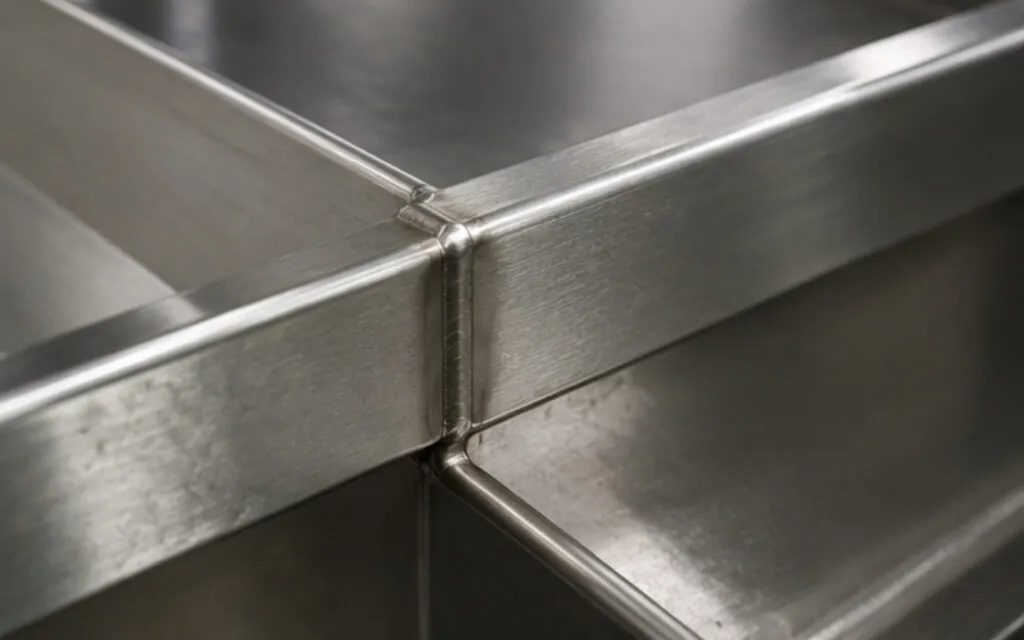
If both are brushed, a finisher on site, arranged by your team, works across both faces with a fine non-woven pad, following the existing grain. The two then read as one surface. Brushed is the easiest finish to blend this way.
If the old surface is badly worn, brushing the full visible face or the whole run gives every piece one finish. It costs more work, and it's the surest way to hide the join.
If the old surface is mill finish or bright annealed and the same sheet can't be found, pick a clearly different finish. A matte, bead-blasted panel beside a brighter surface reads as a choice, not a mistake.
If one new panel would sit in the middle of a short run, replacing its neighbours too lets every visible panel come from one batch, with the grain running the same way.
New panel alone
The fresh panel looks brighter than the worn ones beside it
Blended together
All three faces brushed again along the same lines
A contrast on purpose
A clearly different finish reads as a choice
A finish sample is how the trade agrees on a look before anything is made. It only does that job when it's judged in the right conditions.
Hold the sample against the old piece in the room it's going into. Light from a window or a ceiling fixture can make a good match look poor, or the other way round.
Look at it from where people stand and from the side. A brushed surface changes as you move. Check the match from more than one spot.
Make two samples, so you keep one, and the shop keeps one. Once you approve the sample, the new piece is checked against it, and nobody relies on memory.
Each of these requests leaves the shop guessing about the old surface. A few extra words on the order close the gap.
| What the order says | What goes wrong | What to write instead |
|---|---|---|
| "Match the existing" | Nobody knows the old finish, grade, or grain direction | "Match the existing #4 counter, piece of old stainless supplied, grain running the long way" |
| "Exact match" | Brushed finishes vary, and a shop can't promise exact matches | "Close match, with a finish sample to approve first" |
| "#4 brushed" beside older work | Another supplier's #4 can look quite different | "#4 brushed, checked against the supplied piece" |
| "Same as the old one" beside mill finish | Mill finish comes from the steel mill, and a shop can't recreate it | "Same mill finish and thickness as the existing," or a planned contrast |
| "We'll sand it on site to match" | Rubbing against the grain leaves a bright patch that doesn't match | "Blend with a fine pad, following the existing grain" |
| A counter and splash ordered from different sheets | The two can differ in tone and grain | "Counter and splash from one sheet, grain running the same way" |
Brushing, polishing, and weld blending all happen on our own floor in Pitt Meadows. A finish sample can be brushed before the new piece is made.
Reading what you send. We look at the photos, the sizes, and anything known about the old piece. Then we ask what the new one sits beside.
Telling you what to expect. Before anything is cut, we say whether a close match is likely. If blending or a contrast would look better, we say that too.
Brushing a finish sample when it's agreed. We brush or polish a small panel to compare against your piece, and you approve it.
Laying out the sheet. We work in 304 or 316, from 26 to 14 gauge, with the grain running the way the drawing shows. If the old piece is 430, we'll say how close 304 will come.
Blending and checking. Welds are ground and blended to the approved finish, and the piece is checked against the drawing before it leaves.
Stainless kitchen pieces are typically ready in 1 to 2 weeks once the deposit and approved drawings are in. We also extend and resize existing stainless pieces, and the same matching steps apply. If something doesn't match the drawing and the mistake was ours, we fix or remake it at no charge. Our custom kitchen countertops and stainless steel fabrication pages show the pieces we make.
A close match is enough where nobody walking past would pick out the new piece. Where they would, plan for blending, a refinish, or a contrast.

If we don't think a new piece will match closely enough for where it's going, we'll tell you before you order it, and suggest blending, a full refinish, or a contrast instead. Sometimes the better advice is to leave the old piece alone.
Each item answered here is one less question before the new sheet is brushed. The full list for a quote is in What Duct Duct Goose Needs to Quote Custom Metalwork. More metal choices are in Choosing Materials and Finishes.
The finishes themselves, from mill finish to mirror, are compared in stainless steel finishes explained.
A drawing with every face marked or a phone photo of the old counter are both a fine place to start. Tell us what the new piece sits beside, and we'll say how close a match to expect before the new sheet is ordered.
Standard ductwork and fittings price instantly on WebDuct, the online pricing and ordering portal, with a company account. Stainless, kitchen exhaust, production parts, installs, and other custom work start with a request or a call.
