
Salt and brine in the water
Room-temperature water with up to about 200 parts per million (ppm) of chloride suits 304, and up to about 1,000 ppm suits 316. Brine is far saltier than either, so even 316 needs it rinsed off each shift.
British Columbia

WHERE EACH STAINLESS GRADE HOLDS UP AND WHAT TO ORDER
304 does the job in most kitchens and indoor equipment. 316 earns its place where salt, brine, or sea air touches the metal.
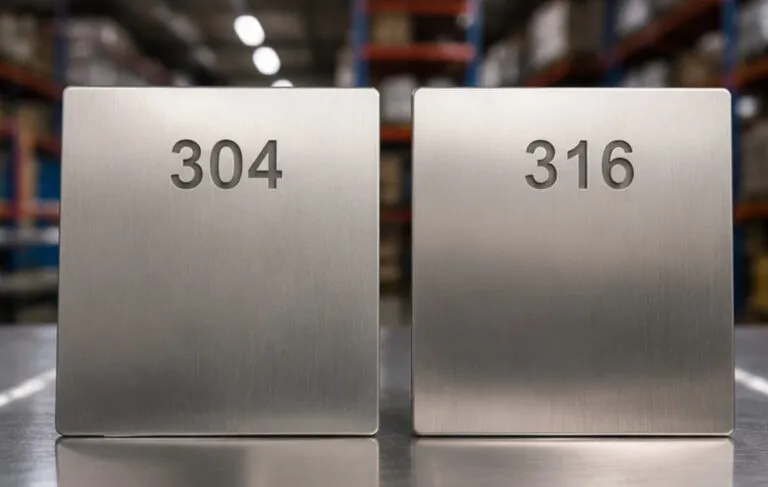
When you compare 304 vs 316 stainless steel, the difference is one added metal, molybdenum. It helps 316 resist the tiny pits salt eats into stainless. In a kitchen where surfaces get rinsed after cleaning, 304 holds up and costs less. Where brine, salty food, or sea air touches the surface, 316 lasts longer. The two look identical, so write the grade on the order. This guide covers where each one belongs, what 316 can't fix, and how to check which grade you have.
Find where your part will sit, and the grade follows from what reaches its surface. When a part fits two rows, order the higher grade of the two.
| Where the part goes | Grade to order | Why |
|---|---|---|
| Counters, shelving, and prep tables that get rinsed and wiped down | 304 | Everyday cleaning that gets rinsed off doesn't leave salt on the metal |
| Sinks and dish areas cleaned with bleach sanitizer | 304, with the sanitizer rinsed off | Sanitizer left to dry pits either grade, so rinsing matters more than the grade |
| Brine, pickling, seafood, or meat prep, rinsed down after each shift | 316 | Salt in brine and cured meat pits 304 faster |
| Hot brine, or salty food left standing for hours | Ask your engineer, or us, about a grade above 316 | Heat and standing salt can defeat both grades |
| Outdoors within about 5 km of open surf | 316 | Sea spray stains 304 brown |
| Entrances and loading docks beside busy salted roads | 316 | Road salt carries onto nearby metal |
| Stainless brackets and equipment parts indoors, away from salt | 304 | No salt or strong cleaner reaches them |
Sheltered inlets carry far less salt than open surf, so many BC sites sit outside the sea-spray row. Grade 316 costs more to buy and weld.
Both grades are mostly iron, chromium, and nickel. Only 316 has molybdenum, and the L versions of each have less carbon for welded parts.
| Grade | Chromium | Nickel | Molybdenum | Commonly used for |
|---|---|---|---|---|
| 304 | About 18% | About 8% | None | Most food service equipment and indoor parts |
| 304L | About 18% | About 8% | None | Welded parts in 304 |
| 316 | 16 to 18% | 10 to 14% | 2 to 3% | Salty foods, brine, and sites near the sea |
| 316L | 16 to 18% | 10 to 14% | 2 to 3% | Welded parts in 316 |
Salt and bleach both cause pitting, but they come from different places and hit different limits. Chloride is the salt part, found in brine, sea air, and road salt. Chlorine is what bleach and sanitizers use.
Room-temperature water with up to about 200 parts per million (ppm) of chloride suits 304, and up to about 1,000 ppm suits 316. Brine is far saltier than either, so even 316 needs it rinsed off each shift.
304 copes with about 2 ppm of chlorine staying on it, and 316 with about 5. Food plants sanitize at up to 100 ppm for a few minutes, then rinse. If sanitizer is left to dry on the metal, either grade can pit, so rinse it off, whatever the grade.
Above 60 °C, neither grade is recommended in salty water, because both can crack without warning. If a part sees hot brine or hot salty wash-down, ask your engineer, or us, about a grade above 316.
How much salt and chlorine each grade tolerates
Room-temperature guidance. Above 60 °C, neither grade is recommended in salty water.
Salt (chloride) in the water
up to about 200 ppm
up to about 1,000 ppm
Chlorine left on the surface, from bleach or sanitizer
about 2 ppm
about 5 ppm
Sanitizing at higher strength for a few minutes is fine when it's rinsed off afterwards. Bars are drawn to scale within each pair, not between the pairs.
Frequent cleaning only calls for 316 when the cleaner or salt stays on the metal. Rinsing after each clean protects 304 in most kitchens.
| What's on the metal | What it does | What to do |
|---|---|---|
| Bleach or sanitizer, rinsed off after use | Little harm to either grade | Keep rinsing with clean water, and 304 holds up |
| Bleach left to dry, or pooled in a drain or corner | Pits either grade over time | Rinse it off, and make sure surfaces drain |
| Brine or salty food splashed during a shift | Pits 304 first | Order 316, and rinse the splash zone at the end of each shift |
| Iron specks from steel wool, or a brush used on mild steel | Leaves specks of iron that rust | Use pads and brushes kept only for stainless |
Some stains hit both grades the same way, and 316 won't stop them. If one of these is behind a stain, fix the cause instead of the grade.
If grinding dust or a tool used on mild steel touches the stainless, the specks rust and stain it. Keep mild steel tools and dust away from stainless parts, as why stainless fabrication costs more explains.
If water and grime sit in a tight seam or on a flat ledge, the metal underneath corrodes. Ask for sloped surfaces and welded seams where water would collect.
If the surface is rough, salt and dirt cling to it and stain sooner. Ask for a smooth finish where salt splashes, as stainless steel finishes explained covers.
If a 316 part is welded with the filler wire meant for 304, the weld has no molybdenum. Ask for 316L filler on 316 parts, and the weld resists salt like the sheet.

The L stands for low carbon, at 0.03% at most. The lower carbon only makes a difference on parts that get welded.
Welding heat can pull chromium away from the metal beside the weld, leaving a strip that corrodes first. Less carbon stops that from happening. The L grades resist corrosion the same as their parent grades everywhere else.
If the part is welded, ask for 304L or 316L. Many mills certify one sheet as both, such as 316/316L, and that sheet meets an order for either one.
Nobody can tell the grades apart by eye, and the magnet test people rely on doesn't work either. These checks show what you have.
| Check | Tells them apart? | What it shows |
|---|---|---|
| A magnet | No | Both grades barely pull, and both pull more once they're bent or rolled |
| The mill's certificate for the sheet, with its heat number | Yes | The grade and chemistry the mill made the sheet to |
| A molybdenum spot test, a drop of chemical on the metal | Yes | Whether molybdenum is in the metal, the sign of 316 |
| A handheld X-ray analyser | Yes | The alloy, though not the carbon, so it can't confirm the L |
If you only know the existing part is stainless, a molybdenum test on site settles the grade. Matching its surface has its own guide on matching an existing stainless finish.
Stainless orders run into trouble when they skip the grade, use a word that isn't a grade, or expect more than the grade can give. Writing 304 or 316 for each part, and where it will be used, avoids all three.
| What the order says | What goes wrong | What to write instead |
|---|---|---|
| "Stainless" | No grade, so the order comes back with a question | "304, brushed finish" or "316, brushed finish" |
| "Marine grade" | It isn't a grade name, and suppliers read it differently | "316", or "316L" for welded parts |
| "316 so it never rusts" | 316 still stains from iron specks and standing water | "316, with surfaces that drain" |
| "304" on a counter for a seafood prep line | Salt and brine pit it in the splash zone | "316L for the welded prep counter and backsplash" |
| "Match the existing" | Nobody knows the existing grade | "Grade from the original drawings, or from a molybdenum test on site" |
Every stainless order is read for its grade before any sheet is cut. It works the same for one shelf or a run of commercial stainless steel fabrication.
The grade is confirmed for each part. We take it from the spec and ask where the part will live if the spec doesn't say.
Built in 304 or 316. We work both grades from 26 to 14 gauge, where a higher number means thinner sheet. Some restaurants ask for 316 counters.
Finished in our shop. Brushing and polishing are done in Pitt Meadows, to the finish the drawings name.
Checked before release. Each piece is checked against the drawings before it leaves. If the mistake was ours, we fix or remake it at no charge.
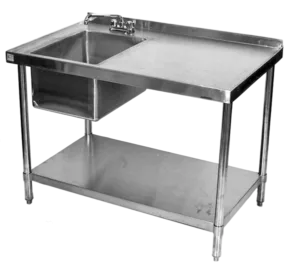
Food prep tables come in 304 or 316, and the same grade question applies to counters and sinks. Tell us where each one sits, and we'll match the grade to it.
Most stainless work is 304, and that's the right call. Grade 316 is worth its price where salt or brine touches the metal.

If 304 will do the job where your part lives, we'll say so before you pay for 316, even if it makes the order smaller.
Tick these off, and the grade on every part is decided before we price it. The checklist for the rest of the job is in What Duct Duct Goose Needs to Quote Custom Metalwork. More decisions like these sit in Choosing Materials and Finishes.
A finished spec and a note saying "it goes beside the dish pit" both work as a starting point. We'll read what you have, ask what touches the metal, and come back with a price once each part is defined.
Standard ductwork and fittings can be priced and ordered on WebDuct, the online pricing and ordering portal, once your company account is set up. Kitchen stainless, grease duct, curbs, installs, and other custom work start with a request or a call.
