
Inside size
Measured between the inner walls of the metal. It's the space the air, or another part, passes through.
British Columbia

WHAT A PHOTO SHOWS US, AND WHAT A DRAWING ADDS
A photo shows what the part is and where it goes, and a drawing says exactly what to cut.
A photo shows a fabricator what the part is, what it connects to, and how it gets into the building. A fabrication drawing says what to build, with every size, the side it's measured from, the metal, the gauge, the finish, and the revision. That's why a photo is often enough to start a quote, and rarely enough to cut metal from. Here's where the gap is, what to add when a picture is all you have, and how a photo turns into a drawing you approve.
Find the row that matches what you're asking for. The closer the part has to fit, the more a drawing matters.
| What you need | Is a photo enough? | Why |
|---|---|---|
| A rough price, to see if the job is worth doing | Often, with the main sizes written on it | A ballpark only needs the type of part and roughly how big it is |
| A simple flat or bent part, like a cover plate | Sometimes, with a sketch showing every size | On a simple part, a sketch with every size can do a drawing's job |
| A replacement for a part you can still get to | It's a start, with the old part measured | The photo shows the shape, and the old part gives the sizes |
| A firm quote | Rarely on its own, but often with a full sketch | The price depends on the gauge, metal, finish, and quantity, which only a sketch or drawing can give |
| A part that bolts to equipment or existing duct | No | Every opening, hole, and connection has to be dimensioned to fit |
| A part on a project with a consultant | No | Shop drawings usually go for review before anything is built |
| A run of repeat parts | No | Every reorder points back to one drawing and its revision letter |
A photo is worth a thousand words, but it can't tell you the gauge. Gauge, tolerance, and the revision letter only exist on the drawing.
| What the drawing says | Why it matters | What a photo shows instead |
|---|---|---|
| Every size, with a tolerance | The tolerance says how far from the size the part can be and still be right | Sizes only where a tape was held, read at an angle |
| Which side each size is taken from | On bent metal, inside and outside sizes need different flat pieces | A tape reading, with no note of which side |
| Bend lines, angles, and which way each bend goes | The press brake folds the part to these | The finished shape, from one side only |
| Hole and cut-out locations | They have to line up with whatever the part bolts to | The holes on the side facing the camera |
| The metal, grade, and gauge | They set the strength, the weight, and how the part is welded | A colour and a shine, with no gauge or grade |
| The finish, and the grain direction on stainless | Visible stainless has its grain laid out to run the same way across the job | The surface the way the light shows it that day |
| The quantity and part number | More parts share one setup, so each part costs less | One part, with no count |
| The revision letter | It records which version of the design was built | No way to tell one version from the next |
A tape in the shot helps, but it can't fix how a camera sees. These four limits are why we ask for sizes even when the photo is sharp.
Anything near the camera looks bigger than it is. So a size read at the front of an opening won't match the size at the back.
One photo can't show how deep something goes. A step, an offset, or an opening set back into a wall all look flat in the picture.
A wide-angle shot bends straight lines, most of all near the edges of the picture. A square opening can look crooked, so we can't trust its angles.
A tape in the shot measures one edge, at that one spot. It can't tell us the size of the side we can't see, or how deep the part goes.
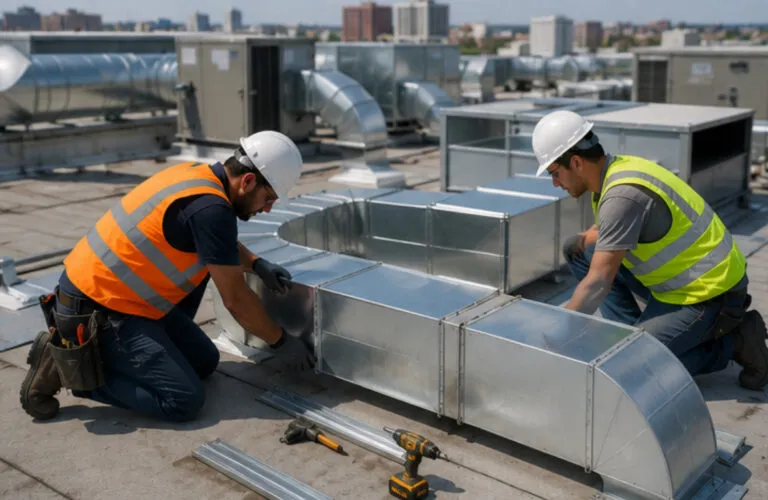
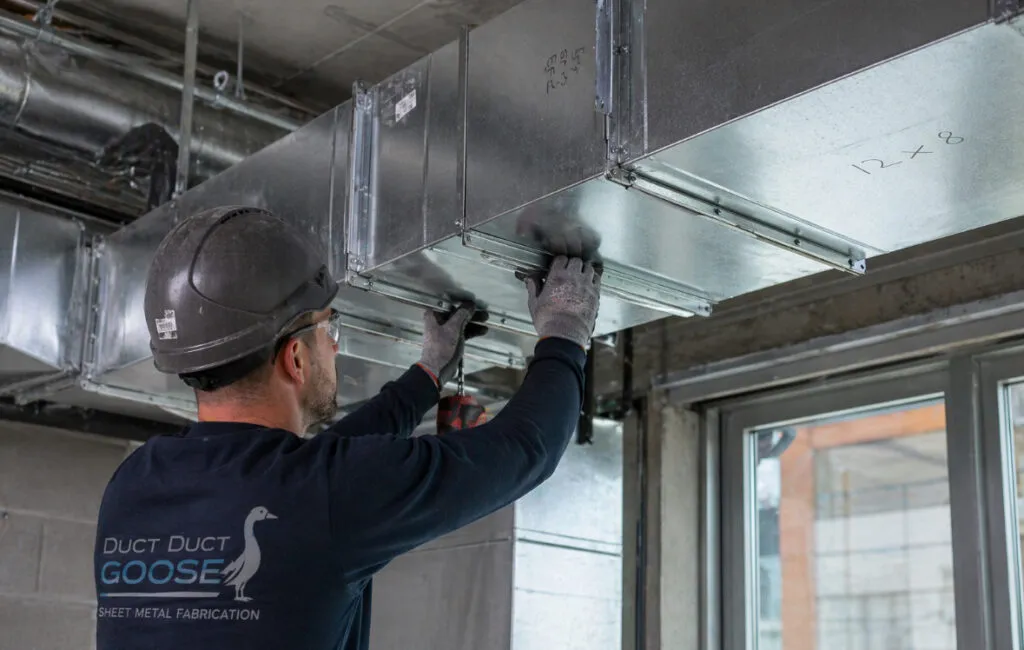
The same opening, as a photo and as a drawing
The photo shows the shape. The drawing says every size and which side it's taken from.
What a photo shows
Taken at an angle, with a tape across one edge
What a drawing says
Every size, the side it's from, the metal and the revision
Sizes are illustrations.
Sheet metal is cut flat and then bent, so a fabricator works backwards from your sizes to the flat piece. That only works when it knows which side each size was taken from.
Measured between the inner walls of the metal. It's the space the air, or another part, passes through.
Measured across the outer walls. It's what has to slide into an opening, a collar, or a frame.
The size of the sheet before it's bent. A bend stretches the metal, so the flat piece isn't the sides added together.
The inside and outside sizes of a duct differ by two thicknesses of metal. That's enough to stop a section sliding into its collar. Which side to measure depends on the part. What matters most is writing down which side you measured. For a duct opening, how to measure ductwork for a custom fitting shows how to take each size from the inside.
A photo still helps. It shows whoever draws the part what to ask about.
A worn bracket, a duct transition, a cover plate. The photo settles the kind of part before anyone measures it.
Pipes, a ceiling, a wall, or another trade's work. These set how big the part can be.
Flanges, a collar, or a bolt pattern on a piece of equipment. The photo shows which ends need sizes.
A stairwell, a ceiling hatch, or a roof. A part too big for the way in has to be made in sections.
Most wrong parts start with something the picture didn't show. Every one of these mix-ups is avoided by what you send with the photo.
| What gets sent | What goes wrong | What to send instead |
|---|---|---|
| A photo and "same as this one" | We can copy the look, but not the sizes | The sizes, or the old part to measure |
| A photo of a worn or bent part | Wear or a bend has changed its shape, so sizes taken from it won't match the original | The original drawing, or the sizes of the parts it fits |
| Sizes with no inside or outside note | The flat piece is worked out from the wrong side | "Inside" or "outside" beside every size |
| A sketch whose sizes don't add up | Nobody can tell which number is right | The overall size, checked against the sizes of each part |
| A first idea sketched as if it's final | We'd build an unfinished design, or the quote leaves out the design work | Say whether the design is final, or ask for it to be drawn |
| A photo of one version and a drawing of another | The part is built to the wrong version | The current drawing revision only |
Two requests for the same part. This is an illustration, not a Duct Duct Goose quote.
A phone photo of a bent bracket on a rooftop unit, with "can you make 4 of these?" We can see it's a bracket with two bends. We can't see the gauge, the hole sizes, or which side the tape was on, so the reply is a list of questions.
The same photo, plus a sketch with every outside size marked, 14 gauge galvanized, two 3/8 inch holes, 4 pieces, needed Friday. That's enough to quote. Once you sign off the drawing, it's enough to build.
Most jobs reach us as a mix of photos, sketches, and sizes. Five steps turn them into something we can build.
Reading what you send. PDF drawings, CAD files (DWG or DXF), photos with tape measurements, and hand sketches all work.
Asking what's missing. We list the sizes, the metal, and any details we still need before we quote.
Drawing it, when you need us to. We can draw the part from your photos and sketch. A drawing fee applies, and it's credited back when you order.
Your approval. You check the sizes, quantities, metal, finish, and openings on the drawing. Your approval is what we build to.
Building to the approved drawing. Parts are cut, bent, and checked against the drawing and its revision before they leave.
Our shop drawings show how to build the part. They aren't engineering drawings. Anything that needs an engineer's stamp comes from the project's engineer. The drawing then runs through our cutting and bending, welding and assembly work, whether it's for custom duct fittings or commercial sheet metal fabrication. The fee is covered in more depth in drawing fees and design assist before fabrication.
We're glad to work from photos and sketches when there's a part to measure or sizes to go on. A photo alone can't carry a job that needs design or engineering.

If your photo shows a standard part, we'll say so. A stock size may do the job with no drawing at all, even if that means we don't make it.
Each item here closes a gap the photo leaves open. What Duct Duct Goose Needs to Quote Custom Metalwork has the full list for any custom job, and more guides sit in Quote-Ready Resources.
A full drawing set works, and so does a phone photo with three sizes on it. We'll tell you what's ready to quote, what still needs a size, and whether we should draw it for you.
Standard ductwork and fittings price instantly on WebDuct, the online pricing and ordering portal, with a company account. Custom parts, stainless, and anything drawn from a photo start with a request or a call.
