
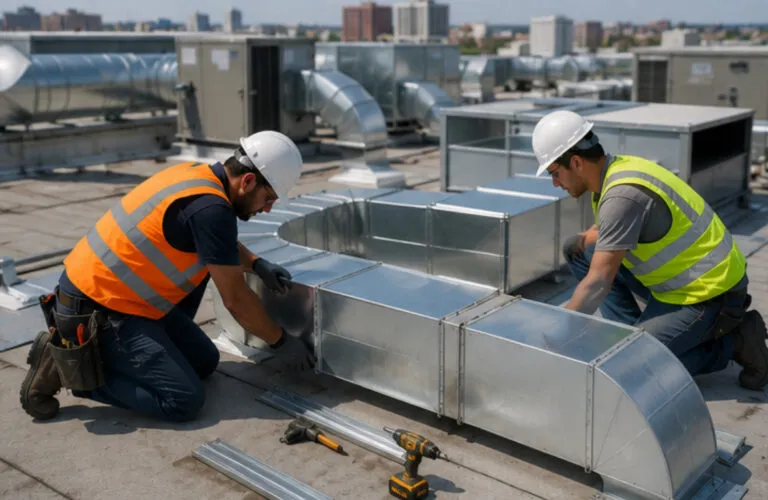
Mill finish
A mill finish can't be brushed back to match after welding, so the weld area will look different. On a part nobody sees, nobody will notice the difference.
British Columbia


THE FINISH DECIDES HOW STAINLESS WEARS, NOT JUST HOW IT LOOKS
Pick the finish by where the piece will live, then by how it looks.
Most custom stainless comes in one of three finishes. A mill finish (2B) is smooth and dull grey, and it costs the least. A brushed finish (#4) has fine lines running one way and suits kitchens and anything people see up close. A mirror finish (#8) reflects like glass and takes the most work to make. This guide shows where each one holds up and what welds and folds do to it. It also shows how to write it on the order, so the piece arrives looking the way your drawing specifies.
Start with where the piece will sit and who will look at it. The answer usually points to one surface.
| Where the piece goes | What to ask for | Why |
|---|---|---|
| Inside equipment, behind a wall, or above a ceiling | Mill finish (2B) | Nobody will see it, so there's no reason to pay for polishing |
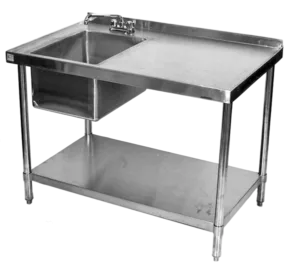
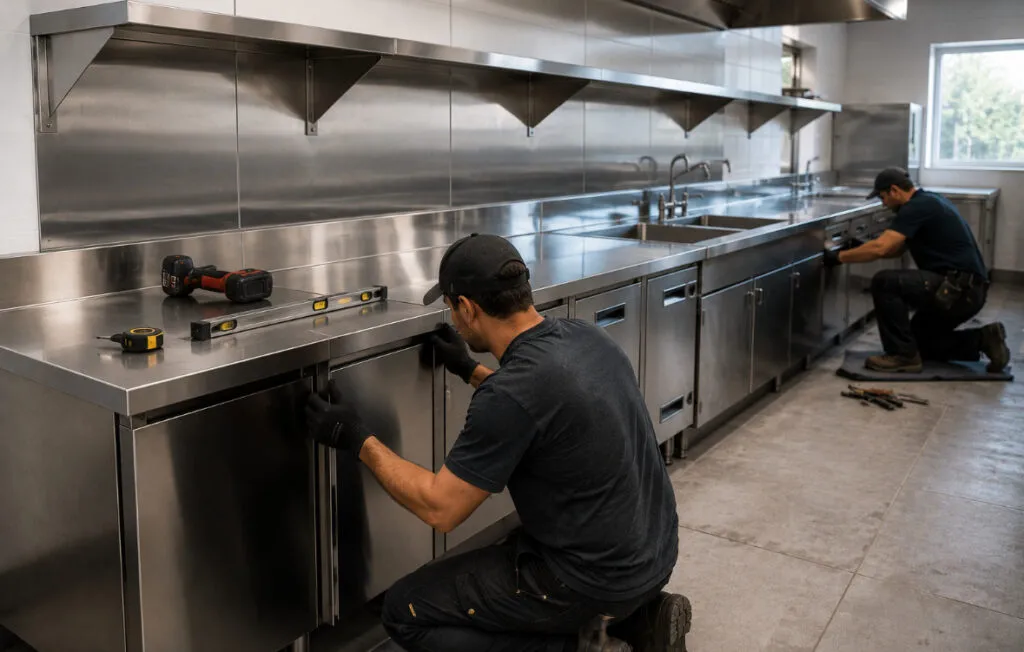
| A kitchen counter, sink, prep table, or shelf | Brushed (#4) | Light scratches that run with the lines hardly show, and it's the standard surface for kitchen equipment |
| Wall panels or trim that sit side by side | Brushed (#4), with the direction of the lines written on the drawing | Panels only look like one surface when their lines run the same way |
| A feature piece people stop and look at indoors | Mirror (#8) | It's the most reflective surface, and it's mostly used for decorative work |
| Outdoors, near the sea | Mirror, or brushed extra smooth, with the lines running up and down | Salt sticks to a rough surface and leaves brown stains |
| You're not sure yet | Tell us where it's going | We'll suggest a surface before anything is cut |
A finish is the texture on the face of the sheet, and the trade names each one with a short code. These three cover most custom work.
| Finish | How it's made | What it looks like | Commonly used for |
|---|---|---|---|
| Mill finish (2B) | Rolled thin at the mill, cleaned, then given a last pass through polished rollers | Smooth and dull grey, a bit like a cloudy mirror | Tanks, process equipment, and parts people don't see or touch |
| Brushed (#4) | Sanded in one direction with abrasive belts | Fine parallel lines with a soft shine | Kitchen and food-service equipment, appliances, and wall panels |
| Mirror (#8) | Polished with finer and finer abrasives, then buffed | Bright and reflective, with polishing lines you only see up close | Decorative indoor panels, column covers, and trim |
Mill finish (2B)
Smooth and dull grey, with no lines
Brushed (#4)
Fine lines that all run one way
Mirror (#8)
Reflects like glass, with no lines you can see
A brushed look isn't identical from one supplier to the next, or even between batches. When a new piece has to sit next to an old one, ask to see a sample first.
The grain is the direction the fine lines run on a brushed sheet. Panels with their lines running different ways can look like two shades of metal under some lighting.
Run the grain the same way on every panel in the run. Write the direction on the drawing, for example, "grain vertical", so every piece is laid out to match.
Say whether the lines should run along the length or across it. On a counter with a backsplash, both parts need the same instruction.
Run the grain up and down. Rain then runs off along the lines, instead of sitting in them with the salt and dirt it carries.
Every sheet in the piece gets laid out with its lines facing the same way. That's only possible when the direction is known before cutting starts.

Grain runs the same way
Two panels side by side read as one surface
same direction on both panels
Grain turned on one panel
The same metal looks like two different shades
direction not written on the order
A weld joins two pieces with heat, and that heat leaves a coloured band beside the seam, called heat tint. Grinding off the tint and the raised weld bead takes the original surface with it. If the shop can make that surface again, the weld can be blended in. If it can't, the weld will show.
A mill finish can't be brushed back to match after welding, so the weld area will look different. On a part nobody sees, nobody will notice the difference.
Brushed is the easiest surface to repair after welding. The weld is ground flat, then brushed again in the same direction as the grain until it blends in.
The weld area has to go back through every polishing step, and a perfect mirror isn't always possible afterwards. Plan welds away from mirror faces where you can.
Folding a part from one sheet avoids the weld and keeps the surface intact. Where joining is unavoidable, our welding and assembly work includes grinding and blending the seam in the shop.
Tea staining is the brown, rust-coloured film that salty air leaves on stainless steel. It's most common within about five kilometres of the surf, and wind can carry it 20 kilometres or more, though sheltered bays see much less. Any piece going near the beach or the waterfront is worth planning for it.
Salt collects in the scratches of a rough surface and holds moisture there. A smoother surface gives it less to hold, and rain washes it off more easily.
Roughness is measured in micrometres and written as Ra, and a lower number means a smoother surface. Industry guidance for stainless near the sea is under 0.5 µm Ra. An order that only says "#4 brushed" can come out rougher or smoother than that. Write the number on the order to be sure.
A mirror polish is the most stain-resistant polished surface and the easiest to wash down. A mill finish that comes through fabrication without damage also holds up well.
Near saltwater, many jobs move from 304 to 316, which resists salt better. The full comparison is in 304 vs 316 Stainless Steel.
A kitchen is hard on any surface, with daily wiping, hot pans, and strong cleaners. The surface you choose decides how much of that shows.
Light scratches that run with the lines hardly show, and fingerprints fade after the first few cleanings. That's why brushed is the usual surface on custom kitchen countertops and stainless food prep tables.
Scratches, grease, and dirt stand out on a large mirror face, and damage is hard to repair. A mirror suits places where people look, not places where they work.
Wiping and scrubbing in the direction of the grain keeps brushed stainless looking even. Scrubbing across it leaves scratches that catch the light.
Brushed and polished sheet usually comes with a thin plastic film that protects it during building. Peel it off once the install is done. Film left out in the sun too long can bake on and get hard to remove.
"Brushed stainless" leaves a lot for the shop to guess. Each line below adds what's missing in a few words.
| What the order says | What's missing | What to write instead |
|---|---|---|
| "Stainless" | The grade and the finish | "304 stainless, #4 brushed on the front and top, mill finish underneath" |
| "Brushed" | Which faces, and which way the lines run | "#4 brushed on every face that shows, grain running the long way" |
| "Polished" | Whether it means brushed or mirror | "#8 mirror on the front panel only" |
| "Match the existing" | A sample, and what it's matching | "Match the existing #4 counter, sample offcut supplied" |
| "Outdoor wall panels" | The grade, how close to the sea, how smooth, and the grain | "316, brushed to under 0.5 µm Ra, grain vertical, 2 km from the beach" |
| "Make it look nice" | Which surface, and where | "#4 brushed on the faces customers see, mill finish on hidden faces" |
Brushing, polishing, and blending welds all happen on our own floor in Pitt Meadows. The people who built the piece also check its surface.
Reading the order. We check the grade, the finish on each face, and the grain direction, then ask about anything missing before pricing.
Laying out the sheets. Stainless comes in 304 or 316, from 26 to 14 gauge. Each piece is laid out so the grain runs the way the drawing shows.
Cutting, folding, and welding. Our stainless specialist handles the detailed work and the TIG welding.
Blending and polishing. Welds are ground and blended to match, and #4 brushing and mirror polishing are done in the shop.
Checking before it leaves. The finished piece is checked against the drawing before it leaves the shop.
Stainless kitchen pieces are typically ready in 1 to 2 weeks once the deposit and approved drawings are in. If something doesn't match the drawing and the mistake was ours, we fix or remake it at no charge. Our stainless steel fabrication page shows the range of pieces we make.
A polished surface earns its cost on faces people see and touch. On hidden faces, a mill finish does the same job for less.

If nobody will see a face, polishing it only adds cost. When we read your order, we'll point out any face that could stay mill finish, even if it makes the job smaller.
Each item answered here is one less question before the metal is cut. More metal choices are in Choosing Materials and Finishes. The full list for a quote is in What Duct Duct Goose Needs to Quote Custom Metalwork.
A full drawing with every face marked or a sketch with "make it look good" scribbled on it are both a fine place to start. Say where it will live, and we'll suggest the surface and grain before anything is cut.
Standard ductwork and fittings price instantly on WebDuct, the online pricing and ordering portal, with a company account. Stainless, kitchen exhaust, production parts, installs, and other custom work start with a request or a call.
