
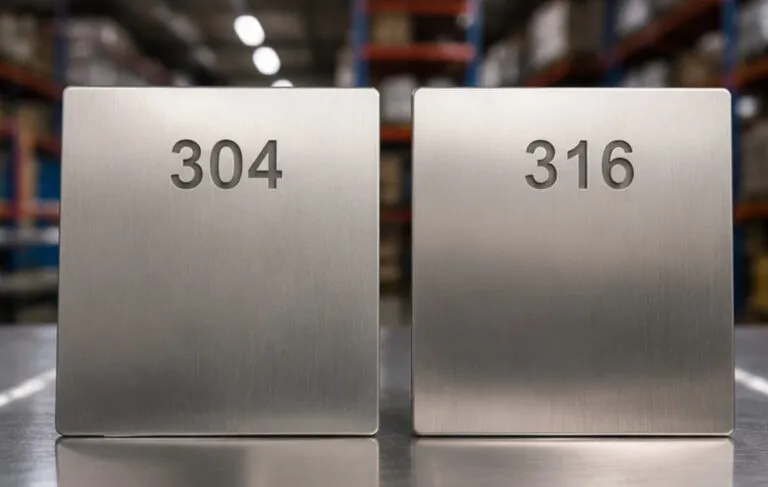
More nickel and some molybdenum in 316
If the spec calls for 316, the metal costs more. Typical 304 holds about 8% nickel, while 316 holds about 10% nickel and 2% molybdenum, and both raise the alloy surcharge.
British Columbia


WHERE THE EXTRA COST OF A STAINLESS PART COMES FROM
Stainless costs about twice as much per kilogram as galvanized sheet, and it takes longer to bend, weld, and clean.
Stainless steel fabrication costs run higher than galvanized for two reasons. The sheet costs more to buy, and every step after it takes longer. It takes more force to bend, welds more slowly, and needs its welds cleaned, and a visible face needs brushing or polishing. This guide puts figures on the metal, shows where the extra hours go, and lists ways to keep the price down.
Not every part costs the same amount more in stainless. Answer these about yours to see where the extra cost will come from.
| Question | If the answer is yes | What it adds |
|---|---|---|
| Will the part be seen once it's installed? | The face gets brushed or polished, and the welds are blended in so they disappear into it | Finishing time |
| Are the corners or seams welded? | Each weld is made more slowly, and the heat tint, a coloured stain around the weld, is cleaned off | Welding and cleaning time |
| Does the spec call for 316? | The steel holds more nickel and some molybdenum, and it welds more slowly | A higher metal price and more welding time |
| Does it have to match stainless already on site? | A sample is needed, and an exact match may not be possible | Trial and finishing time |
| Are you ordering only one or a few? | Setup and handling are shared by fewer parts | Setup time spread over fewer parts |
A one-off costs more for reasons that have nothing to do with the metal. Why small custom metal parts cost more covers that side of the price.
Global Affairs Canada tracks the value of every steel shipment brought into Canada. Its figures put 300 series stainless, the family 304 and 316 belong to, at about twice the value of galvanized or mild steel sheet.
| Sheet | Thickness | Average import value per kg, Canadian dollars, not a Duct Duct Goose quote |
|---|---|---|
| Stainless, 300 series, cold rolled | Over 1 mm and under 3 mm | $3.22 to $3.30 |
| Stainless, 300 series, cold rolled | 0.5 mm to 1 mm | $3.64 to $3.81 |
| Galvanized | Over 1 mm | $1.69 to $1.77 |
| Galvanized | 0.5 mm to 1 mm | $1.61 to $1.66 |
| Mild steel, cold rolled | All thicknesses | $1.58 to $1.62, not a Duct Duct Goose quote |
Each range runs from one year's average to the other's, for the last full year and this year so far. These are values declared at the border for large coils and sheets, so cut sheet from a local supplier costs more per kilogram. The ratio still holds, with stainless at about 1.9 times galvanized over 1 mm and 2.2 to 2.4 times on thinner sheet.
304 and 316 are the two grades most stainless work uses, and 316 costs more for two reasons. Choosing between them is covered in 304 vs 316 stainless steel.
If the spec calls for 316, the metal costs more. Typical 304 holds about 8% nickel, while 316 holds about 10% nickel and 2% molybdenum, and both raise the alloy surcharge.
If the part is 316, the welder slows down and takes more care, because 316 is more prone to cracking as the weld cools. That adds welding time on top of the metal price.
Gauge is the number used for sheet thickness, and a lower number means thicker metal. A thicker sheet costs more because it weighs more and needs more force to bend.
If you write a gauge number on the order, add the thickness in millimetres beside it. Millimetres read the same to every supplier, so every quote prices the same sheet. Sheet metal gauge vs thickness explains why.
NFPA 96, the grease duct standard, sets the minimum at No. 16 gauge for mild steel and No. 18 for stainless. If your local inspector allows either, thinner stainless narrows the price gap.
Our grease ductwork fabrication page covers the duct we make in mild steel and stainless. The authority having jurisdiction has the final say on what a kitchen needs.
Most of the extra cost is shop time. Each step below takes longer, or uses more sheet, in stainless than in galvanized or mild steel.
| Step | Galvanized or mild steel | Stainless steel | Why it costs more | |
|---|---|---|---|---|
| Bending | The usual force on the brake | About one and a half times the force | Stainless is stronger, so it takes more force and springs back more after each bend | |
| Welding | MIG welds, or soldered corners on galvanized | Often TIG welds, which are slower | TIG is slower, but it gives the control a thin, visible stainless weld needs | |
| Cleaning the welds | Not needed to stop rust | The heat tint around each weld is ground or cleaned off | The tint weakens the steel's resistance to rust until it's removed | |
| Finishing a visible face | Usually none | Brushing or polishing, with welds blended in, meaning ground and brushed to match | A weld on show has to disappear into the finish around it | |
| Film and handling | Handled as delivered | Film left on, and sheets lifted instead of dragged | A scratch or a speck of mild steel shows on stainless | |
| Laying out the parts | Parts turned any way to fit the sheet | Parts kept with the grain, the direction of the brushed lines, running one way | Brushed parts have to match, so fewer fit on each sheet and more sheet is used |
One drain pan, made in two metals
Hours assumed for illustration, not a Duct Duct Goose quote. Orange marks the 1.5 hours stainless adds.
Galvanized, soldered corners
1.5 hours304 stainless, welded corners
3 hoursSpecks of mild steel left on stainless steel rust, and the rust shows on the surface. Keeping them off takes care that a galvanized part doesn't need.
If a wheel or wire brush has touched mild steel, it leaves specks of it on the next sheet it touches. So stainless gets grinding wheels and brushes of its own.
If stainless sits on a mild steel rack or slides across a dirty bench, it picks up specks of steel. That's why it's stored upright and lifted, never dragged.
If the protective film comes off early, the face scratches and picks up dirt. Leaving it on until the end means fewer marks to polish out.
If rust spots appear on a new part, mild steel picked up during fabrication is the usual cause. Raise it with the fabricator while the spots are still on the surface.

The same condensate drain pan, made in two metals, shows where the extra money goes. The galvanized pan has soldered corners, and the stainless pan has welded ones, two common ways drain pans are made.
| Example in Canadian dollars, hours assumed, not a Duct Duct Goose quote | Galvanized, soldered corners | 304 stainless, welded corners |
|---|---|---|
| Sheet used, about 7 kg, at the average import value | $12.39, at $1.77 a kg | $23.10, at $3.30 a kg |
| Cutting and folding, hours at the $32.17 sheet metal worker wage | 1, for $32.17 | 1.25, for $40.21 |
| Corners, hours | Soldered, 0.5 at $32.17, for $16.09 | Welded, 1 at the $37.50 welder wage, for $37.50 |
| Cleaning the welds, hours at $37.50 | None | 0.75, for $28.13 |
| Total, not a Duct Duct Goose quote | $60.65 | $128.94 |
The wages are the Lower Mainland medians from the Government of Canada's Job Bank. Stainless more than doubles the total, yet the metal is only $10.71 of the $68.29 difference. The rest is shop time. Local cut sheet costs more than the import value, and a billed rate adds overhead, so a quote's gap is wider still. Our stainless steel condensate drain pan page covers the pans we make.
Most savings come from the steps a part needs. Each one below keeps the part doing its job.
If a face is hidden once the part is in place, leave it mill finish, the plain surface the sheet arrives with. Nothing has to be brushed there.
If a corner can be folded instead of welded, there's no weld to make, clean, or blend. Ask whether your part allows it.
If the part isn't near salt water or harsh cleaners, 304 often does the job. It costs less to buy and weld.
If the drawing shows which way the grain runs, the parts are laid out once, with no guessing and no second sheet.
If a part fits on one sheet, it needs no joining seam. That's one less weld to make and blend.
If several parts are ordered together, the setup and handling are shared. Each part then carries less of it.
Stainless steel finishes explained helps you pick the finish each face needs. Brushing only the visible faces is often the biggest saving on the list.
A price often rises because of something left off the request. Each fix below names what to send instead.
| What was asked for | Why it costs more | What to send instead |
|---|---|---|
| "Stainless," with no grade | The shop has to ask, or price the grade it guesses | Name 304 or 316 on the drawing |
| A brushed finish on every face | Faces nobody will see are brushed too | Mark which faces will be on show |
| A gauge number with no thickness | Two shops can price different sheet | Add the thickness in millimetres |
| An exact match to old stainless on site | Matching takes trial pieces and extra finishing, and may still fall short | Send a sample piece and ask how close a match can get |
| Welded corners where a fold would work | Each weld adds welding, cleaning, and blending | Ask whether a folded corner will do the job |
| Blended welds on a part nobody sees | Blending time is spent where no one will look | Ask for welds cleaned but not blended |
A stainless price is built from the metal, the welding, and the finish. These steps run the same for a drain pan or a full kitchen order.
Send the drawing with the grade, gauge, and finish. We work in 304 and 316, from 26 to 14 gauge.
We ask about anything that moves the price. We start with visible faces, welded corners, and where the part is going.
We price a lower-cost option beside yours. If a fold or a mill finish would do the job, you'll see both prices.
We weld and finish in our own shop. Welds are blended into a #4 brushed or polished face as the part is made.
Work starts once drawings are approved and the deposit is in. Stainless kitchen pieces typically take 1 to 2 weeks, depending on order size.
Our stainless steel metal fabrication page covers what we make in stainless. The welding and assembly page covers how the parts are joined.
Stainless pays for itself where water, food, grease, or salt would wear out a lower-cost metal. Where the part stays dry and clean, galvanized usually does the job for about half the metal cost.

If galvanized will do the job, we'll say so and price it that way. We'd rather sell you the right metal than the more expensive one.
Galvanized vs stainless steel weighs the two metals for each kind of job. A part that stays dry rarely needs stainless at all.
With these on the first request, the price comes back closer to the part you need. It also saves a round of questions.
More cost guides sit in Custom Fabrication Cost Guides. What affects the cost of a custom stainless steel countertop applies all of this to counters.
Clean drawings or a rough sketch with sizes are both enough to start. Tell us where the part is going, and we'll tell you what's missing and where stainless is worth it.
Standard ductwork and fittings price instantly on WebDuct, the online pricing and ordering portal, with a company account. Stainless, grease duct, production parts, installs, and other custom work start with a request or a call.
