
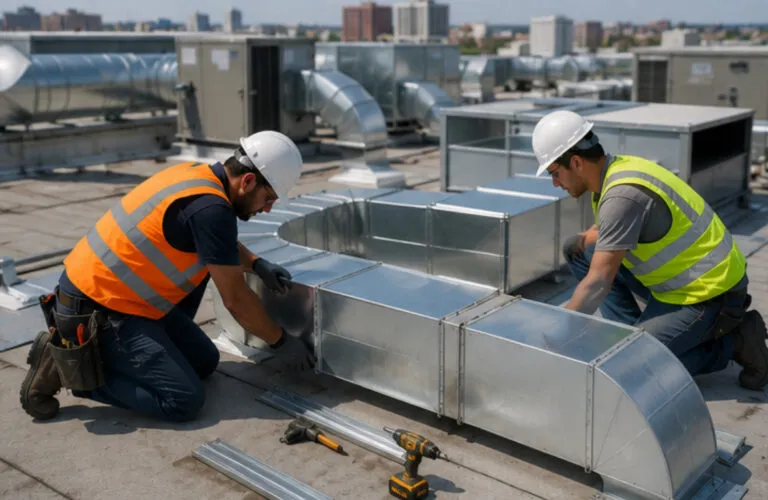
Galvanized, steel with a zinc skin
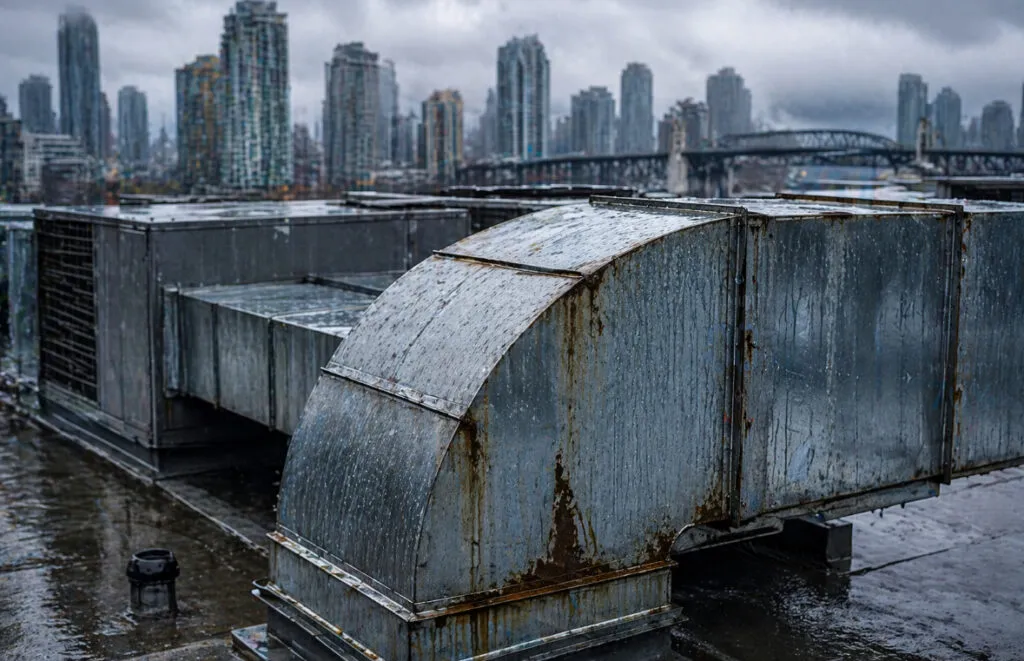
The protection sits on the surface. If the coat wears through in a wet run, the steel underneath rusts. Small scratches are covered by the zinc around them, and bigger damage gets a zinc-rich paint touch-up.
British Columbia

WHERE GALVANIZED DOES THE JOB AND WHERE A PART NEEDS STAINLESS
Galvanized steel is the standard for duct in dry, heated space. A part that stays wet or touches food moves to stainless, and grease duct moves to mild steel or stainless.
Choosing galvanized vs stainless steel comes down to what each run, one connected length of duct, carries and what reaches its surface. Galvanized duct lasts in dry, heated buildings and costs less to buy and build. Grease duct needs mild steel, plain steel with no zinc coat, or stainless by code, and food-contact surfaces are built in stainless. Runs that stay wet or carry chemicals need more than a zinc coat. This guide goes run by run, explains how galvanizing works, and shows what to write on the order.
Find each run or part on your list. The usual metal follows from what the run carries, and the engineer's spec has the last word.
| Run or part | Usual metal | Why |
|---|---|---|
| Supply and return duct in heated space | Galvanized | Dry air leaves the zinc coat alone |
| Rooftop curbs and flashing | Galvanized with a heavier coat, or painted | Weather wears the zinc faster than indoor air |
| Dishwasher exhaust | The engineer's choice of metal, welded watertight | The run stays wet and drips condensation |
| Grease duct | Mild steel or stainless, welded | NFPA 96, the grease duct standard, allows only those two metals |
| Fume hood exhaust | Welded stainless, unless the chemicals need something else | Lab and process fumes can corrode a zinc coat |
| Condensate drain pans | Galvanized, or stainless under copper coils or where water stands | Standing water and copper both wear zinc away faster |
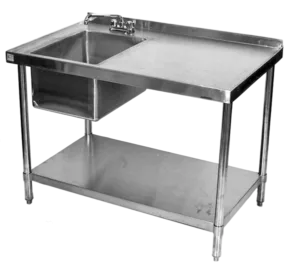
| Counters, tables, and sinks that food touches | Stainless | It stays smooth and easy to clean |
The usual metal for each run in one building
A simplified cross-section. The engineer's spec has the last word on every run.
Stainless costs more to buy and to build. The gap, with Canadian figures, is on why stainless fabrication costs more.
Galvanized steel is ordinary steel with a coat of zinc. The zinc protects it in two ways, and both work best in dry indoor air.
| Coating | Zinc on the sheet, both sides together | Commonly used for |
|---|---|---|
| G60, also written Z180 | 180 g per square metre | Indoor duct, and SMACNA's duct construction tables assume it |
| G90, also written Z275 | 275 g per square metre | Parts out in the weather, unless they're painted |
Canadian project specs name different coatings, from light ones such as Z90 to heavier ones such as G90 (Z275). Copy the one your spec names onto the order.
Stainless steel isn't galvanized, and it doesn't need to be. It resists rust because of what's in the metal, not because of a coat on top.
The protection sits on the surface. If the coat wears through in a wet run, the steel underneath rusts. Small scratches are covered by the zinc around them, and bigger damage gets a zinc-rich paint touch-up.
Stainless holds at least 10.5% chromium. The chromium forms a thin film on the surface that repairs itself in air, and a scratch heals over without a coat.
A coat on top, or protection all the way through
Sheet cross-sections, not to scale.
Galvanized steel
The zinc wears away first and protects the steel at scratches. Once it's gone, the steel rusts.
Stainless steel
Chromium runs through the whole thickness. The thin surface film repairs itself in air, so a scratch heals over.
Zinc lasts a long time in dry air and wears away quickly where water or chemicals stay on it. If a run matches one of these, ask whether it needs stainless.
Zinc lasts when it dries out between wettings. If a run stays damp, like a dishwasher or shower exhaust, the zinc corrodes away much faster.
SMACNA, whose standards duct is built to, notes that galvanized does well only where the air carries no chemicals. If a run carries lab or process fumes, the engineer picks the metal.
When zinc touches copper or stainless and water joins them, the zinc corrodes faster. If copper coils drip condensate onto a galvanized pan, ask for a stainless pan instead.
Galvanized sheet or duct stacked tight while wet grows a white powder called white rust. It looks bad but usually uses up little of the zinc. When duct arrives on site, keep it under cover and up on pallets or blocks, so water can't sit between the pieces.

Grease duct follows NFPA 96, the standard BC's building code points to for commercial cooking. It lists two metals, and galvanized isn't one of them.
| Metal | Allowed for grease duct? | Minimum thickness |
|---|---|---|
| Mild steel | Yes, welded liquid-tight | No. 16 gauge |
| Stainless steel | Yes, welded liquid-tight | No. 18 gauge |
| Galvanized steel | No, it isn't on the list | None |
Grease duct is welded all the way along. Welding through zinc gives off fumes that WorkSafeBC lists as a cause of metal fume fever, a flu-like illness. The full rules are on grease duct specifications, and our grease ductwork page covers what we make.
British Columbia's Food Premises Regulation asks for food-contact equipment that is durable, easily cleaned, and free of anything toxic. Stainless steel is what fits these standards best, and what most food equipment is built from.
If food sits on it, build it in stainless. It stays smooth and easy to clean after years of scrubbing.
If a wall, pan, or shelf gets hosed down every night, it rarely dries. Stainless handles that, while zinc wears away where it stays wet.
If the duct only carries air through a dry ceiling, galvanized does the job, even above a kitchen. Grease duct and dishwasher exhaust are the exceptions.
Once a part is stainless, choose the grade. Areas with brine or salt water often need 316, as our article on 304 vs 316 stainless steel explains.
Each of these orders names the wrong metal for a run or leaves out a detail, usually the zinc coating or the stainless grade. Writing the metal and that detail for every run prevents both.
| What the order says | What goes wrong | What to write instead |
|---|---|---|
| "Galvanized" on the grease duct | NFPA 96 doesn't allow galvanized for grease duct | "Grease duct, 16 gauge mild steel or 18 gauge stainless, welded" |
| "Galvanized throughout", with dishwasher exhaust on the list | The wet run wears through long before the rest | "Dishwasher exhaust welded watertight, metal per the spec" |
| "Galvanized curb", with no coating named | A light indoor coat on a rooftop part wears out sooner | "G90 galvanized curb", or "G60, painted" |
| "Galvanized pan" under a copper coil | Dripping condensate eats the zinc next to the copper | "Stainless drain pan" |
| "Stainless", with no grade | The order comes back with a question | "304" or "316", for each part |
Every order is read run by run for its metal before any sheet is cut. It works the same for one curb or a full HVAC ductwork package.
The metal confirmed for each run. We take it from the spec, and ask what the run carries if the spec doesn't say.
Curbs and filter boxes in galvanized. We make roof curbs and filter boxes in galvanized steel.
Grease duct in mild steel or stainless. It's welded to the kitchen's drawings and never made in galvanized.
Drain pans in galvanized or stainless. Stainless suits pans under copper coils, and the corners are welded or soldered as the job requires.
Checked before release. Each piece is checked against the drawings, and if the mistake was ours, we fix or remake it at no charge.
We work galvanized, aluminum, and mild steel from 30 to 14 gauge, and stainless from 26 to 14. The engineer's spec sets the metal, and the local building official approves it.
Galvanized is the right metal for most duct in most buildings. Stainless is worth its price on the runs and parts that stay wet, carry grease, or touch food.

If galvanized does the job on a run, we'll say so before quoting stainless, even if the order gets smaller.
Tick these off, and every run has its metal before we quote. The checklist for the rest of the job is in What Duct Duct Goose Needs to Quote Custom Metalwork. More decisions like these sit in Choosing Materials and Finishes.
A full set of drawings and a duct list with "kitchen?" written beside a run both give us enough to begin. We'll read what you have, ask what each run carries, and come back with a price once the metal is set.
Standard ductwork and fittings can be priced and ordered on WebDuct, the online pricing and ordering portal, once your company account is set up. Kitchen stainless, grease duct, curbs, installs, and other custom work start with a request or a call.
