
Have an Engineer Check It Before You Buy
The BC Building Code allows used equipment only if it meets the rules for new equipment. Peachland and Gibsons also ask for a professional engineer to certify it. Have the engineer look before you pay.
British Columbia

WHAT TO CHECK WHEN AN EXISTING KITCHEN CHANGES
Before anything moves, have the hood, the fire suppression, and the duct checked against the new cooking line. Each was designed for the old one.
In a commercial kitchen renovation, swapping an appliance for a similar one usually leaves the hood alone. Adding a fryer, moving the cooking line, or changing the menu is different. Each can change the hood's overhang, the air it has to draw out, and where the fire suppression nozzles point. In BC, that usually means an engineer's design, a revised building permit, and the health officer's approval. This guide covers which changes affect the hood and duct, what to check on site, and who signs off.
Most kitchen changes start under the hood, and the work above follows. Find your change in the left column to see what it can affect and what it usually brings.
| The change | What it can affect | What it usually needs |
|---|---|---|
| Swapping an appliance for a similar one | Usually nothing above the cooking line | Often no permit, as Peachland and Gibsons say, though Vancouver wants one when appliances change, so check your city |
| Adding a fryer, griddle, or range | The hood's overhang, how much air it draws out, and where the nozzles point | An engineer's design and a revised permit, with the fire protection contractor adding nozzles before the new appliance is used |
| Moving appliances under the same hood | Where the nozzles point, and how evenly the hood draws air along its length | A revised permit in Vancouver, with the fire protection contractor re-aiming the nozzles before cooking resumes |
| Making the cooking line longer | Whether the hood's overhang still covers every appliance | A longer hood or a second one, sized by the engineer |
| Moving the hood | The distance to anything nearby that can burn, and the duct route to the roof | A revised permit, with clearances and fire protection checked again |
| Cooking with grease under a hood built for steam | The hood type, the duct, and the need for fire suppression | A Type 1 hood built for grease, with welded grease duct and fire suppression, in place of the Type 2 steam hood |
| Taking over a former restaurant | Whether the old system was approved for the cooking you plan | A check of what the space was approved for, before the lease is signed |
| A bigger exhaust fan | The air speed in the duct, and the make-up air that replaces what the fan draws out | The engineer rebalancing the make-up air to match |
Coquitlam's guide points out that some existing kitchens were only ever approved for cooking that gives off no greasy fumes. If your menu adds frying or grilling, read Type 1 vs Type 2 kitchen hoods before you sign anything.
It fits only if the new line stays inside what the hood was tested and listed for. The hood's overhang, how far it extends past the cooking on each open side, is the first limit a bigger line breaks.
A hood has four limits, and a change to the cooking line can break any one of them. The listing label sets three, and the hood maker's instructions set the fourth.
| What the hood has to do | Where the rule comes from | What changes it in a renovation |
|---|---|---|
| Overhang the cooking surface on every open side | The listing label, or 150 mm (6 in.) for a hood without a listing in Vancouver | A wider appliance, or one added at the end of the line |
| Draw enough air out over the cooking | The label's minimum airflow, or the engineer's sizing | Heavier cooking, such as a charbroiler or wok range in place of a fryer |
| Hang at the right height | The label's hanging height | A taller appliance, or a hood moved to a lower ceiling |
| Keep its listing | The hood maker's instructions | Drilling or cutting into the canopy to extend it, which can void the listing |
The same hood, before and after a fryer is added
A hood has to overhang the cooking on every open side, as its listing label says.
Before the change, the line fits the hood
The hood overhangs both ends of the line, as its label asks.
After a fryer is added at the end
Part of the fryer sits outside the hood's overhang. The hood, the airflow, and the nozzles all need another look.
If you'd rather lengthen the hood than replace it, ask the hood maker first. Only the maker can say whether an extension keeps the listing.
The fire suppression system is the set of nozzles, pipes, and a tank that sprays a fire-stopping agent over the cooking line. It's designed around the appliances under it, so a change to the line is a change to the system.
Each nozzle is placed and aimed for the appliance under it, at a set height and distance. If an appliance moves or changes, a nozzle can end up pointing at empty space. Book the fire protection contractor to re-aim or add nozzles before cooking resumes.
Keep a fryer 406 mm (16 in.) from the open flames of the appliance beside it, or fit a steel divider 203 mm (8 in.) high between them. Both keep hot oil away from the flame. If the new line can't give the gap, show the divider on the drawings.
BC required kitchen suppression systems to switch from dry chemical to wet-chemical systems listed to ULC 300 years ago. A fire protection contractor red-tags an old one that hasn't been upgraded. If the kitchen you're taking over still has one, budget for a new system.
The system is serviced every six months, and each service starts by checking that it suits the appliances under it. After a change, don't wait for the next visit. Have the fire protection contractor check it before cooking resumes.

An existing grease duct was built for the old hood and the old menu. Run these checks before a new hood is joined to it.
| What to check | Why it matters | Who checks it |
|---|---|---|
| A clean duct letter | It shows the duct is free of grease before new work joins it, and Vancouver asks for one when old duct is reused | An exhaust cleaner certified by ASTTBC, the BC body for fire protection technicians |
| The cleaning label on the hood | The label shows when the system was last cleaned | You, before asking for prices |
| The cleaner's report | It lists any part of the duct the cleaner couldn't reach | You, with the engineer |
| Access panels along the duct | Vancouver wants them on existing duct too, so every section can be cleaned | The engineer marks where they go, and the sheet metal contractor adds them |
| The fire-rated enclosure and the clearances | A moved hood or rerouted duct sits at new distances from anything that can burn | The engineer, with the general contractor for the enclosure |
| Air speed in the duct | A bigger hood on an old duct changes how fast the air moves, and that speed has limits | The engineer, against the grease duct rules |
The slope, access panels, and air speed limits a grease duct has to meet are in grease duct requirements. Access panels and new sections for an old duct are part of our grease ductwork.
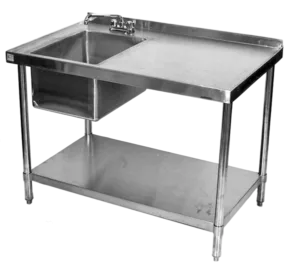
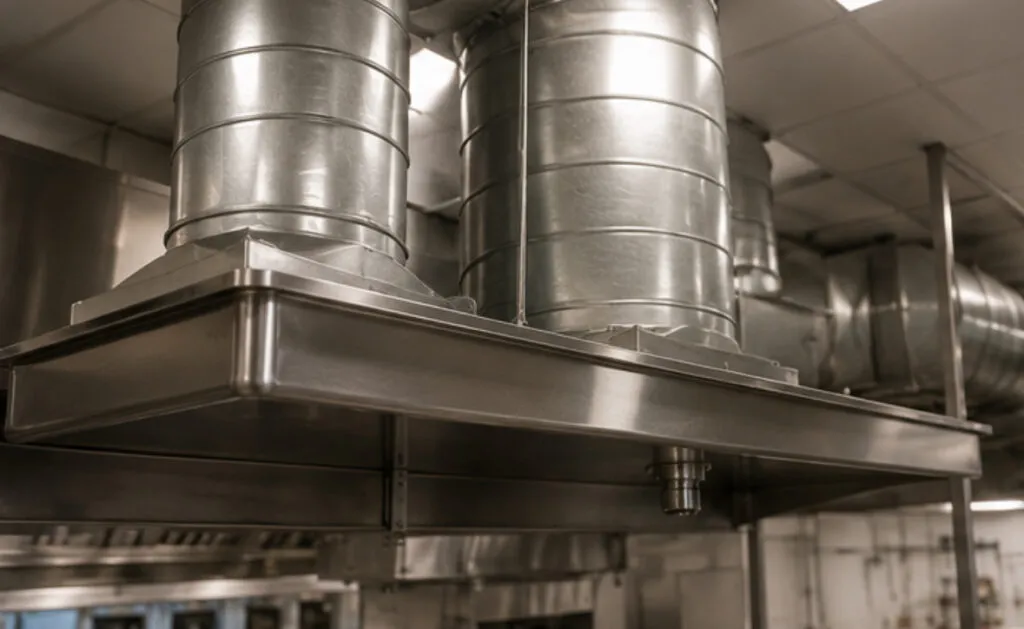
A used hood can look like a saving, but British Columbia rules treat it like new equipment. Three checks come before the money changes hands.
The BC Building Code allows used equipment only if it meets the rules for new equipment. Peachland and Gibsons also ask for a professional engineer to certify it. Have the engineer look before you pay.
The installer works from the hood's listing label, so it has to be there and readable. If the canopy has been drilled or cut, the listing may be void.
A hood from another kitchen was sized for that kitchen's appliances. Check its overhang and airflow against your own cooking line before it goes up.
Approvals come before construction, and they follow roughly this order. Each city sets its own rules, and its guide says what a change needs.
The health officer approves the new layout. BC's Food Premises Regulation bars changes to a kitchen until a health officer approves the plans.
An engineer designs the change. A professional engineer registered in BC seals the drawings. The engineer's letters of assurance go in with the permit.
The city issues a revised building permit. Vancouver asks for one when the appliances change or the hood moves. Coquitlam also wants its fire department's approval.
The gas fitter gets a gas permit. Moving, adding, or removing a gas appliance needs one before work starts. It comes from Technical Safety BC or the city.
The work is inspected and signed off. The engineer reviews it on site. The building inspector and health officer then finish their checks before cooking starts.
A renovation happens in a building that's already in use, often with a restaurant next door or upstairs. These checks keep the work safe and stop it from being halted partway.
Before renovation work starts, WorkSafeBC requires a qualified person to check for asbestos, lead, and other hazardous materials, with a written report. The rule has no year cut-off, so newer buildings aren't skipped.
The BC Fire Code asks whoever welds on site to protect anything that can burn up to 15 m away. Someone has to watch for fire during the welding and for at least an hour after. Agree on who keeps that watch before welding starts.
Grease inside an old duct can catch fire from the heat of a weld. The Fire Code calls for precautions before welding on metal that touches anything that can burn. Book the cleaning before the ductwork.
Cleaning chemicals can coat the suppression system's fire detectors, as one maker's manual warns. Have the fire protection contractor check the system once the cleaning is done.
Most renovation surprises come from assuming the old system still covers the new kitchen. Each of these costs less to catch on paper than on site.
| The mistake | What happens | What to do instead |
|---|---|---|
| Treating the old hood as approved for the new menu | A kitchen approved for steam cooking can need a full grease hood system | Check what the space was approved for before signing the lease |
| Adding a fryer without telling the fire protection contractor | No nozzle covers the new fryer | Book the contractor before the fryer arrives |
| Squeezing a fryer in beside a range | The 406 mm gap or the steel divider is missing | Show the gap or the divider on the drawings |
| Buying a used hood before anyone checks it | It may need an engineer's sign-off, or its listing may be void | Have the engineer look at it first |
| Connecting to the old duct without a cleaning report | Grease and missing access panels turn up after the new hood is hung | Book the cleaning first and read the report |
| Moving the line before the permit | The work can be stopped until the approvals catch up | Get the health and building approvals, then move |
We install hoods and grease duct, so our part of a kitchen change is the metal above the cooking line. A renovation runs through these five steps.
Seeing the kitchen as it stands. Photos with a tape measure in frame are a good start. Field measuring is available as a separate price when the duct needs it.
Reading the engineer's drawings for the new line. Suppression, gas, and design questions go to the trade that owns them.
Quoting our part, and naming the rest. The quote covers the hood, new grease duct sections, access panels, transitions, and equipment connections. It names the work other trades do, such as suppression, engineering, roofing, and the roof fan.
Welding the new grease duct. New sections are welded in mild steel or stainless, as the drawings specify. Each follows SMACNA and the NFPA 96 requirements on the drawings. They're typically ready 1 to 2 days after the deposit and approved drawings, depending on the order's size.
Hanging the hood and joining the duct. The hood comes from a hood maker, and our installers hang it and connect the duct.
If something doesn't fit because we got it wrong, we fix or remake it at no charge. Our kitchen hood supply and installation and commercial kitchen exhaust work cover new kitchens as well as changes. How to measure ductwork for a custom fitting shows what makes a useful photo.
We weld grease duct and hang hoods, so a renovation that changes those is ours. Everything else on the system belongs to another trade.

If your change is a like-for-like swap that fits under the hood as it is, you may not need us at all. We'll say so as soon as we see it.
A few photos and lists tell us most of what a site visit would. What Duct Duct Goose Needs to Quote Custom Metalwork has the list for any custom job. The trades behind each part are in the kitchen exhaust scope of work, and the other kitchen guides sit in Kitchen Exhaust and Food-Service Fabrication.
Engineer's drawings or a phone photo of the hood's label both get the conversation going. We'll tell you what the change means for the hood and duct, quote our part, and name what belongs to other trades.
Standard ductwork and fittings price instantly on WebDuct, the online pricing and ordering portal, with a company account. That includes the supply ductwork on a kitchen job. Hoods, grease duct, installs, and other custom work start with a request or a call.
