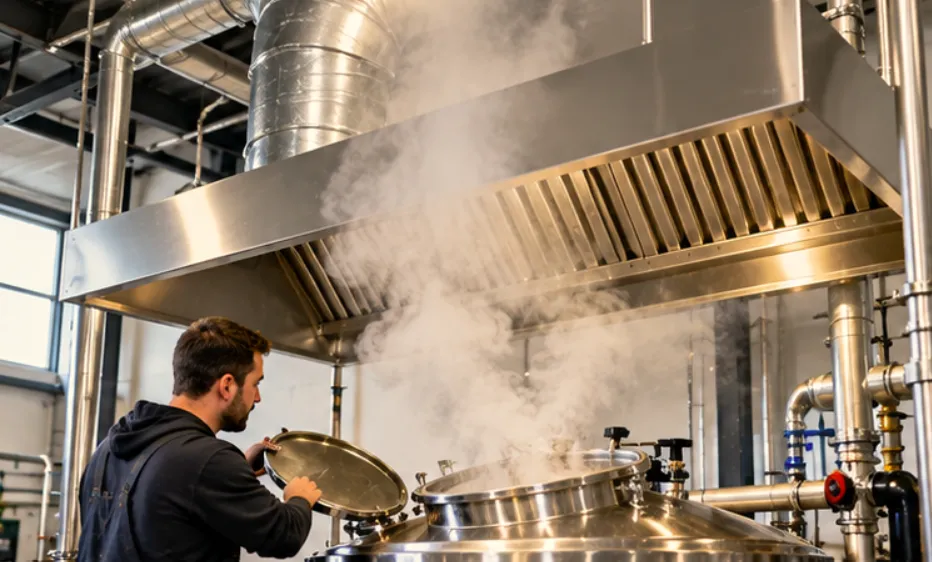
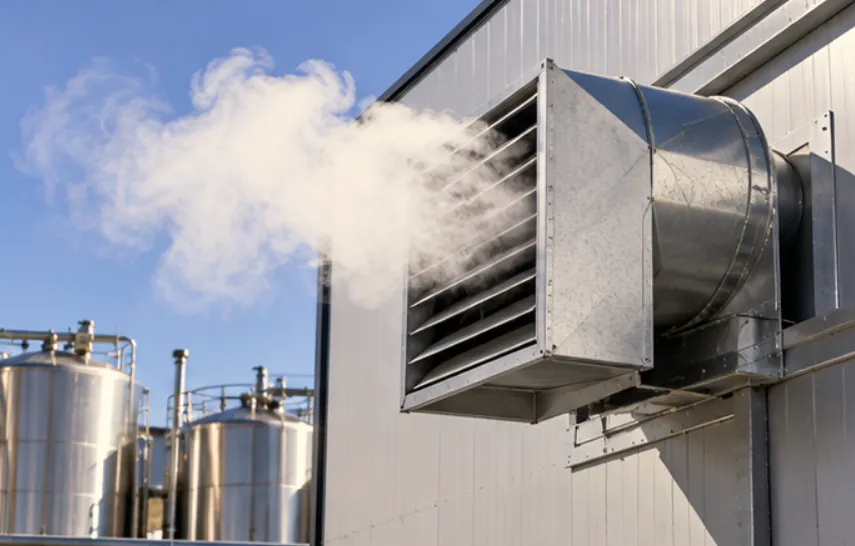
Kettle steam rises and CO₂ sinks, so a brewhouse needs two separate exhaust paths. A hood over the kettle pulls steam out through a corrosion-resistant duct, while low-level extraction clears carbon dioxide from around the fermenters.
Cleaning stations add moisture and chemical vapour on top of both. Treating all three as one exhaust problem leaves either a wet ceiling or CO₂ sitting where nobody can smell it.
What Does Brewery Ventilation Need to Control?
Each part of a brewery puts something different into the air. The kettle, the cellar, and the cleaning station each need their own answer.
| Brewery area | Main concern | Ventilation consideration |
|---|---|---|
| Brew kettle | Steam and heat | A hood close to the kettle |
| Whirlpool and hot-liquid equipment | Heat and water vapour | Hood coverage and exhaust routing |
| Fermentation tanks | CO₂ accumulation | Low-level extraction plus gas detection |
| CO₂ storage and dispensing | Leaks from tanks and lines | Gas detection and a safety plan |
| Cleaning stations | Moisture and chemical vapours | Exhaust matched to the chemicals in use |
Local exhaust catches steam and gas at the source, while general ventilation keeps the whole room in check. Most brewhouses need both.
A two-barrel taproom and a production brewery need different layouts, so batch size, equipment placement, and brew-day schedule all shape the design.
How Should a Brewhouse Exhaust Hood Capture Steam?
A rolling boil puts out a column of hot, wet air that spreads across the brewhouse if nothing catches it. Left alone, it raises the humidity and drips off every cold surface it finds.
A brewhouse exhaust hood catches that plume close to the kettle. Its size, height, and shape come from the kettle’s dimensions and how hard you boil.
Five things decide whether a kettle hood does its job.
Hood Coverage
The hood has to reach past the kettle’s edge so the plume can’t slip around it. Any gap along one side becomes the path the steam takes.
Mounting Height
Every extra bit of distance between the kettle and the hood gives the plume room to spread. Mount it as low as the brewers can comfortably work under.
Tanks, Pipes, and Overhead Lines
Nearby tanks, pipe runs, and cable trays often decide where the hood can go. Mapping them first saves moving the hood after the duct is hung.
Drafts From Doors and Supply Air
An open loading door or a supply diffuser aimed at the kettle can push steam sideways, away from the hood. Supply air has to come in where it helps the capture.
Room to Clean and Service
Brewers climb up to clean the hood and service the kettle, so both need clear access. A hood that blocks the manway turns every cleaning day into a fight.
Bigger isn’t automatically better. Too much exhaust burns energy heating replacement air, and too little lets moisture into the room, so your ventilation designer sets the size and airflow.
Which Materials Work Best for Brewery Steam Exhaust Ductwork?
Steam exhaust duct carries hot, wet air that cools and condenses on the way out. That makes corrosion, leaks, and standing water the things to plan the metal around.
| Material or feature | Key considerations for brewery steam exhaust |
|---|---|
| Stainless steel | Stands up to constant moisture and harsh cleaning chemicals, which makes it a common pick near the kettle |
| Galvanized steel | Can work on cooler, drier runs farther from the kettle, where the spec allows it |
| Welded or sealed joints | Keep air and condensate inside the duct instead of dripping from the seams |
| Condensation management | Duct sloped to a drain, insulation where the spec calls for it, and a way out for the water |
| Inspection and cleaning access | Access panels let your crew check for corrosion and residue before it becomes a leak |
Our equipment exhaust fabricators weld stainless steel ductwork for the wettest runs and build the rest in metal and gauge your spec names. The stainless or galvanized decision is worth settling before the first cut. Steam duct and CO₂ duct are planned as separate systems because the two exhausts behave in opposite ways.
How Should Breweries Manage CO₂ Around Fermenters?
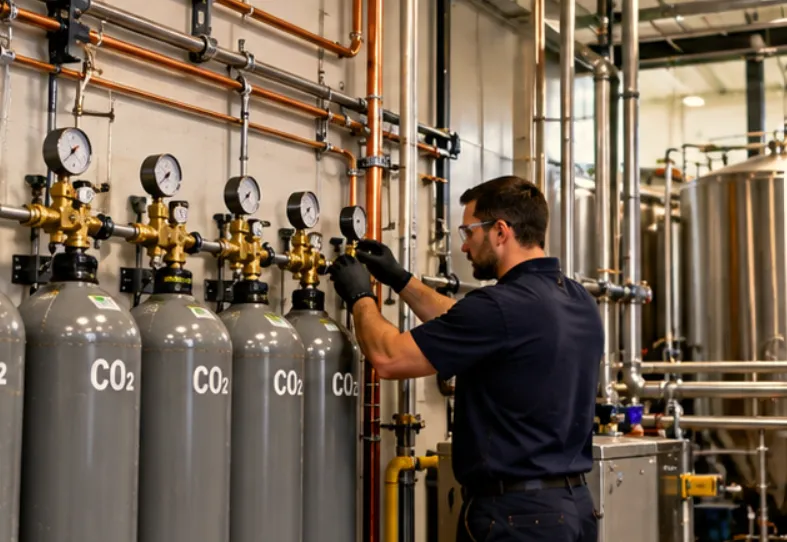
Fermentation gives off carbon dioxide (CO₂), and because it’s heavier than air, it collects near the floor, in pits, and in the bottom of tanks. It’s colourless and odourless, so nobody notices it building up without a gas detector.
Four parts of a brewery’s CO₂ plan touch the ventilation.
Low-Level Extraction Near the Fermenters
Exhaust grilles set near the floor pull CO₂ out of cellars and pits where it pools. The duct then carries it outside to a discharge point your engineer sets.
Makeup Air for the Cellar
Air pulled out at floor level has to be replaced, or the extraction can’t move enough of it. Replacement air is planned with the exhaust, not added afterwards.
Fermenter Blow-Off and Vent Lines
Gas vented from the tanks is routed to the vessel manufacturer’s instructions and its pressure-safety rules. That routing belongs to your engineer and the vessel supplier.
Gas Detection, Training, and Emergency Plans
CO₂ monitors, alarms, and staff training belong to the brewery’s safety plan rather than the ventilation system. WorkSafeBC’s advisory on CO₂ in craft brewing covers the exposure limit and recommends CO₂ monitors alongside proper ventilation. Never send anyone unprotected into an area where CO₂ may have built up.
The ventilation designer sets the exhaust locations, airflow, and discharge for each cellar, and our fabricators build the duct to those drawings.
Why Does a Brewery Need Makeup Air?
Every exhaust fan pulls air out of the building, and something has to replace it. Without makeup air, the brewery goes into negative pressure, doors fight back, and the hoods stop catching well.
Makeup air comes back in through a wall louver, a filter box and damper, and the supply duct behind them. It has to arrive where it helps the kettle hood, without blowing steam off course or leaving the brew crew in a draft.
Your ventilation designer balances five things.
| What the designer balances | Why it matters |
|---|---|
| Exhaust and makeup air quantities | The air coming in has to match the air going out |
| Where supply air enters | A diffuser aimed at the kettle pushes steam away from the hood |
| Building pressure | Negative pressure makes doors hard to open and pulls air from next door |
| Winter and summer air | Replacement air has to be heated or cooled, which costs energy |
| Equipment running at once | Peak brew days set the size, not the quiet ones |
Commissioning then checks that the system moves the air the design says it should.
What Do You Need Before Ordering Brewery Exhaust Ductwork?
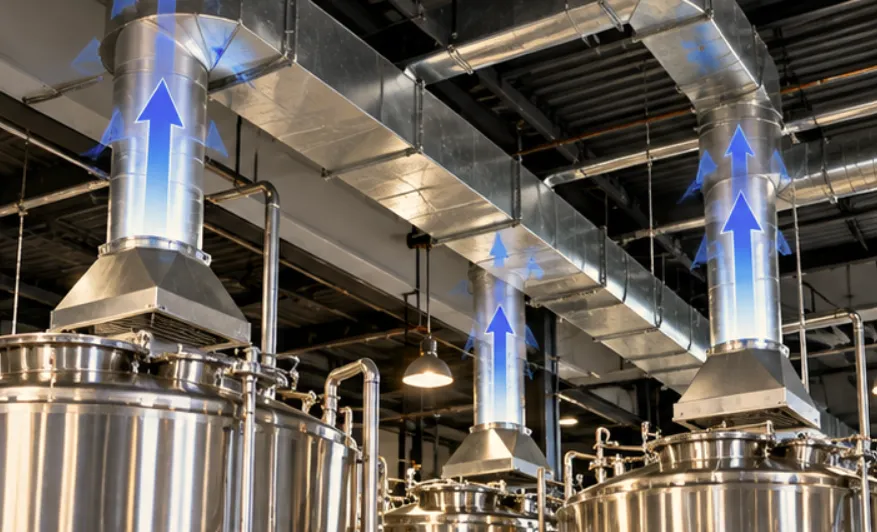
Brewery equipment is big, the ceilings are often tight, and the brewers need room to work. Duct sizes, connection points, and the route are confirmed before any sheet metal is cut.
Settling the hood size, duct layout, metal, joints, supports, and access panels with your project team keeps the install free of clashes and rework.
Bring these to the quote.
- Kettle, fermenter, and other equipment dimensions
- Approved drawings with hood locations, duct routes, and connection sizes
- The metal type, gauge, and finish your spec calls for
- The design’s condensate and drainage details
- Where access panels go for inspection and cleaning
- Clearances, supports, and any clashes with other trades
Our sheet metal contractors build each run to those drawings and flag a missing or conflicting detail before production.
Your engineer owns the airflow, the hood geometry, the CO₂ controls, and the code requirements.
Who Builds the Steam and CO₂ Exhaust Duct for a BC Brewery?
The Duct Duct Goose crew supplies and installs equipment exhaust ducting, and helps lay out the run with your engineer. A single-kettle taproom gets the same welds and labelled sections as a full production brewery.
Once the drawings are approved and the deposit is in, most duct packages are ready in a day or two.
Planning a new brewhouse or adding tanks? Our equipment exhaust ducting handles the kettle and cellar runs, and breweries sit alongside the other industries we build for. Send us your drawings, and we’ll build the duct that sends the steam up and the CO₂ out.
Brewery Ventilation Questions
Does every brew kettle need its own exhaust hood?
Not always. Kettles set close together can sometimes share one hood, depending on their size, spacing, and how much steam they put out. Your ventilation designer decides whether a shared hood can catch it all.
Can brewery steam exhaust and CO₂ exhaust share the same duct?
Plan on keeping them apart. Steam is hot, wet, and rising, while CO₂ is cool and pools low, so the two need different pickup points, materials, and discharge. Your engineer makes the final call.
Is stainless steel always the best material for brewery exhaust ductwork?
No. Stainless earns its cost on the wet runs near the kettle and in wash-down areas. Galvanized can work on cooler, drier runs where the spec allows it.
Is low-level exhaust enough to make a fermentation cellar safe?
No. Low-level exhaust clears CO₂ that pools, but it doesn’t replace gas detection, staff training, and an emergency plan. All four belong in the brewery’s safety plan.
Where should brewery CO₂ exhaust discharge?
Outside, and away from doors, windows, and air intakes, so the gas can’t drift back into the building. Your engineer sets the exact discharge point.