
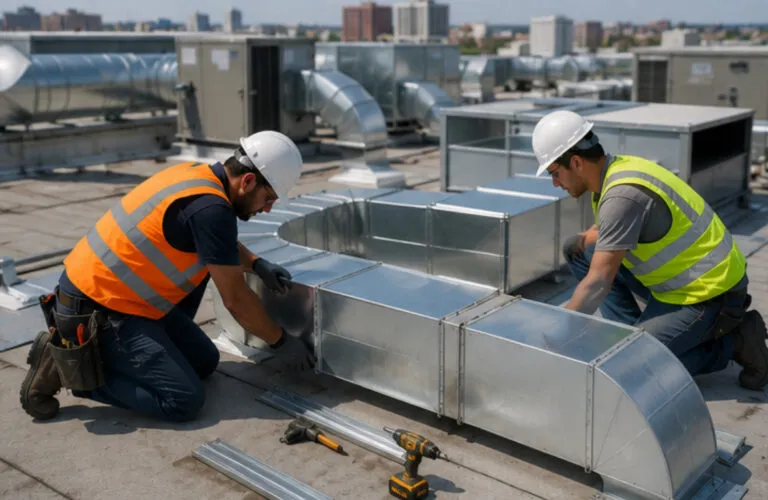
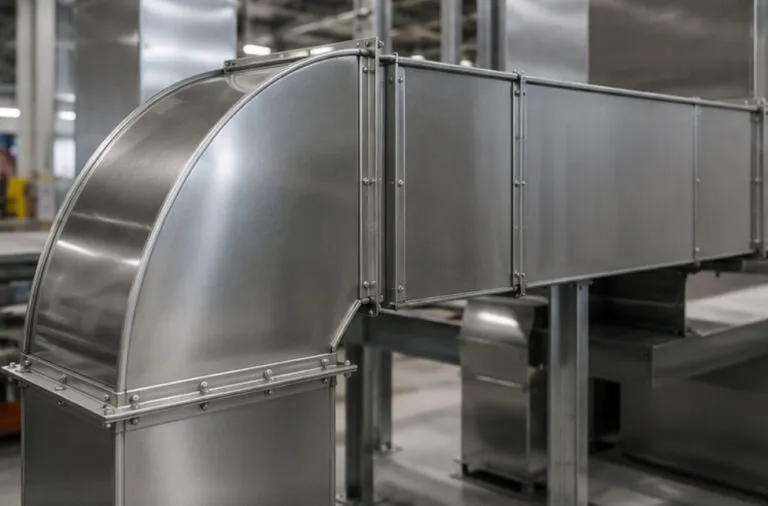
Square elbows with turning vanes
If a tight corner can't fit a radius elbow, specs call for a square elbow with vanes inside. Stock lines don't carry them, so they're made.
British Columbia


CHOOSING BETWEEN STOCK DUCT FITTINGS AND FITTINGS MADE TO SIZE
A stock fitting is the quicker buy when its sizes match your run, and a fitting made to size is the answer when they don't.
Stock duct fittings are the ready-made elbows, reducers, and takeoffs a supply house keeps on the shelf. They cover small round branches and shallow residential trunk well. Most commercial runs, with deeper duct, heavier gauge, beams in the way, and units to connect, need some fittings made to size. This guide shows where stock stops, which fittings usually get made, and what cutting a stock part on site costs you.
The size and shape the run needs decide whether a stock fitting would work, or whether your project needs it made custom. Find the closest match below.
| What the run needs | Stock or made to size | Why |
|---|---|---|
| A round branch of 14 inches or less, in a standard size | Stock | Supply houses carry these sizes ready-made |
| Rectangular trunk 8 inches deep, 26 gauge or lighter | Stock | Shallow trunk is sold ready-made for houses |
| Rectangular duct of any other depth, or heavier than 26 gauge | Made to size | Stock rectangular comes mostly 8 inches deep, in residential gauges |
| A square elbow that needs turning vanes | Made to size | Stock lines don't include vaned elbows |
| An offset around a beam or a pipe | Made to size | The step has to match where the beam or pipe sits |
| A connection to a rooftop unit or air handler | Made to size | It has to match the unit's openings |
| A square-to-round | Made to size | Stock lines don't include it |
How to specify a duct fitting covers what goes on the order once you know a fitting has to be made. It explains bends, joints, and transition angles one at a time.
A Canadian maker's published range shows what stock covers. It's built around houses, with small round pipe and trunk only 8 inches deep.
| Stock item | Sizes a Canadian maker lists | Commonly used for |
|---|---|---|
| Round pipe | 3 to 10 inches in 1-inch steps, plus 12 and 14 inches | Small supply and exhaust branches |
| Adjustable round elbows | 90-degree from 3 to 16 inches, and 45-degree in 4, 5, and 6 inches | Turning a small round branch |
| Round reducers | Fixed pairs only, such as 6 to 4 inches or 8 to 6 inches | Stepping a branch down one size |
| Round takeoffs | 4 to 8 inches in 1-inch steps, plus 10, 12, and 14 inches | Branches off a trunk line |
| Rectangular trunk | 8 inches deep, 8 to 30 inches wide in 2-inch steps, 30 to 26 gauge | Trunk lines in houses |
| Rectangular elbows and reducers | Only in the 8-inch-deep sizes | Turns and steps in house trunk lines |
| Plenums | Sized to standard furnace cabinets | Residential furnaces |
The same range lists no vaned elbows, no square-to-round, and no rectangular duct at commercial sizes. That's where a run starts needing fittings made for it.
No supply house stocks these fittings, and commercial jobs need them often. The shape of the space decides each one.
If a tight corner can't fit a radius elbow, specs call for a square elbow with vanes inside. Stock lines don't carry them, so they're made.
A beam or pipe in the run's path means the duct has to step around it. The step has to match how far the duct must move to clear it.
When the duct changes size to meet a unit, the transition is sized to both ends. Unit openings vary, so each transition fits its own unit.
Where a rectangular trunk feeds a round duct or fan outlet, a square-to-round fitting joins them. Each one is cut to its own two sizes.
A plenum on a commercial unit is sized to that unit's cabinet. Stock plenums fit standard furnace sizes only.
When a branch leaves a trunk deeper than stock sizes, its takeoff is made to fit. The trunk's size sets the takeoff's shape.
A stock part that nearly fits can be cut, crimped, or pieced together on site. Each fix adds joints, labour, or a problem with the spec.
If a stock fitting is cut and pieced together, every new joint is another place air can escape. SMACNA research found joints leak far more than seams.
If an elbow is forced tight or set right at a fan outlet, airflow drops. AMCA, the fan industry's body, calls for 2.5 duct diameters of straight duct before the first elbow.
When installers cut and fit parts on site, you pay installer wages for shop work. Job Bank lists the Lower Mainland median HVAC mechanic wage at $42.00 an hour (a wage figure, not a Duct Duct Goose quote).
If the spec calls for radius elbows or set transition angles, a cut-down stock part may not meet them. Some project specs ban adjustable elbows outright.

One duct run stepping around a beam
Every joint is a place air can leak. Orange dots mark the joints in each run.
Two stock elbows and a piece cut on site
4 jointsOne offset made to size
2 jointsA transition joins two duct sizes or shapes. Three situations put it beyond anything a shelf carries.
If one end is rectangular and the other round, or both sides change size, no stock part joins them. The transition is drawn from both ends.
If the space is short, the transition gets steep. Specs cap the angle because air can't follow a steep change, so a short space needs a shape worked out for it.
If a unit's outlet sits to one side of the duct, the transition has to shift sideways as it changes size. That shift is set by your measurements.
A unit's openings set the size of the duct that meets it. Getting those sizes right before anything is cut is the most important part of the job.
A rooftop unit's duct usually attaches to its roof curb, not the unit's base, as Carrier's installation guide says. So measure the curb's openings.
If a fitting meets a unit, send the model number with the sizes. We need both to make curbs, curb adapters, and the duct that ties them in.
If a replacement unit doesn't match the old curb, a curb adapter joins them. We make it in galvanized steel in both sets of sizes.
If the unit is already installed, measure its openings where the duct will meet them. Note the model number too, so we can look up any opening you can't reach.
Our roof curbs and flashing page covers the curbs and adapters we make. How to measure ductwork for a custom fitting shows how to measure where a fitting meets equipment.
Fittings ordered with the straight duct arrive with it, so the crew isn't waiting on one piece. One order also keeps the pricing and the delivery together.
When the fittings ship with the straight duct, every piece reaches the site together. We deliver by our van or a delivery service.
On a larger order, pieces can be labelled by floor, area, or system. Ask for the labels you need when you send the list.
Straight duct and the fittings WebDuct lists price as you enter the sizes, including fittings made to size like offsets and transitions. Shapes it doesn't list go to a quote.
Once the order is approved and a deposit is in, a fitting made to size typically takes 1 to 2 days, depending on the order.
Which ductwork prices instantly on WebDuct shows which pieces you can order online. Our HVAC ductwork fabrication page covers the duct packages we make.
A fitting made to size only fits the sizes it was made for. What happens when the site changes depends on when the change comes and who measured.
If a size changes before you sign our shop drawing of the fitting, the drawing is updated, and nothing is cut yet. That's the cheapest time to change it.
If the site changes after the fitting is made, it may need remaking. When the space changes, or a size you sent was off, the remake is a new order.
If your sizes were right and the fitting isn't, that's on us. We fix or remake it at no charge.
If beams, pipes, or ceilings are still going in, wait for them before measuring. A size taken too early is the most common reason a fitting changes.
Who is responsible for field-verified dimensions covers who answers for each size. What happens after shop drawing approval covers what a change costs once the drawing is signed.
Most of these come from buying stock for a spot that needed a fitting made for it. Each fix below keeps the crew installing.
| What happened | What it costs | What to do instead |
|---|---|---|
| Stock elbows bought for a run with a beam in the way | The crew cuts and patches an offset on site | Send the beam's position and have one offset made |
| A transition sized from the drawings alone | The transition missed the off-centre outlet and was remade | Measure the unit's openings or send its model number |
| Fittings ordered after the duct arrived | The run stalls while the fittings are made | Order them with the straight duct |
| A stock reducer bought one size off | A second adapter, and two more joints that can leak | Order one fitting at the exact sizes |
| Sizes taken before the ceiling was framed | The space changed, and the fitting was remade | Measure once the space is final |
Most runs need some of each, so we look at the whole list. These steps are the same for five fittings or fifty.
Send the whole fitting list with the run. Include the sizes, a photo, and where each piece goes.
We say where stock does the job. If a supply-house part fits, we'll tell you to buy it there.
Listed pieces are priced on WebDuct. Straight duct and listed fittings are priced as you enter the sizes, even when they're made to size.
We quote the rest from your drawing. Anything WebDuct doesn't list is priced from your drawing or sketch.
Everything ships or waits for pickup together. We can add the spiral and snap-lock pipe we buy in.
Our custom duct fittings page covers the fittings we make, from elbows and offsets to plenums.
A stock part costs less than one made to size and wins on speed when it fits. A fitting made to size wins when nothing on the shelf matches the space.

If a supply-house elbow fits the run, buy it there. We'll say so, even when it means a smaller order for us.
With these in the first message, the fitting can be priced and made without a round of questions. Sizes alone are rarely enough.
What Duct Duct Goose needs to quote custom metalwork has the full list for a quote request. More guides on ordering duct sit in HVAC Ductwork and Fittings.
Clean drawings or a rough sketch with sizes are both a starting point. Send the run, and we'll tell you what's missing and which pieces need making.
Ductwork and the fittings we list price instantly on WebDuct, the online pricing and ordering portal, with a company account. Kitchen stainless, grease duct, curbs, installs, and other custom work start with a request or a call.
