Skip to content

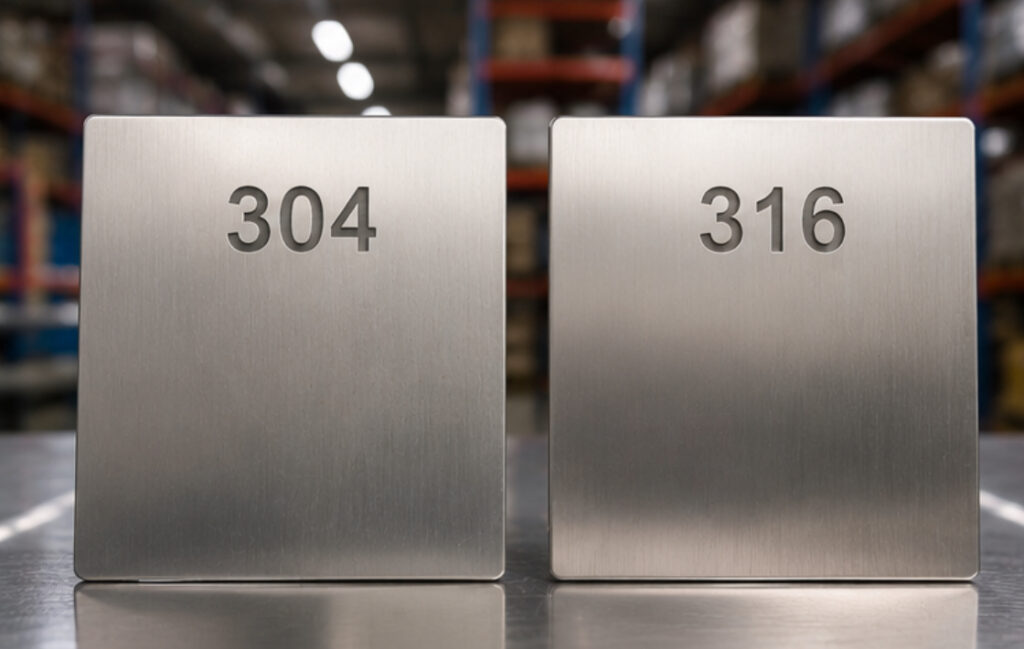
Choosing between 304 and 316 stainless steel for a commercial kitchen, food-processing area, or wash-down space is not simply a matter of choosing the “better” grade. Both are widely used stainless steels, but their resistance to moisture, chlorides, cleaning chemicals, and corrosive conditions is different.
For a Greater Vancouver project, that distinction can matter. A restaurant kitchen may experience grease, steam, frequent cleaning, and food acids, while a food-processing facility may have repeated wash-downs involving stronger cleaning chemicals. A component exposed to salt, chlorides, or aggressive sanitation conditions may need more corrosion resistance than a component operating in a relatively dry environment.
The practical question is therefore: What will the stainless component be exposed to, how often, and for how long? That answer should guide the specification, along with fabrication requirements, expected service life, appearance, and budget.
What Is the Difference Between 304 and 316 Stainless Steel?

The primary difference is their alloy composition. Both 304 and 316 are austenitic stainless steels with good corrosion resistance, but 316 contains molybdenum, which improves its resistance to chloride-related corrosion and certain aggressive environments.
That doesn’t make 304 a low-quality material. In many commercial kitchens and general food-service applications, 304 provides the corrosion resistance needed without the additional material cost associated with 316.
| Characteristic | 304 Stainless | 316 Stainless |
|---|---|---|
| General corrosion resistance | Very good | Excellent |
| Chloride resistance | Good, but more limited | Better suited to chloride exposure |
| Typical commercial kitchens | Common choice | Useful for more aggressive conditions |
| Frequent wash-down | Suitable depending on chemicals | Better for demanding conditions |
| Material cost | Generally lower | Generally higher |
| Best reason to specify | General durability and value | Increased corrosion resistance |
The choice should therefore be based on the environment rather than automatically specifying 316. Using 316 where 304 would perform adequately can increase fabrication costs without providing a meaningful benefit. This applies whether you are ordering stainless steel ductwork, a countertop, or a full commercial sheet metal package.
When Is 304 Stainless Steel a Good Choice for a Commercial Kitchen?

304 is often a practical starting point for commercial kitchen fabrication because it provides strong general corrosion resistance while remaining more economical than 316. It can be suitable for components exposed to normal kitchen moisture, food-service conditions, steam, and routine cleaning when aggressive chloride exposure is not a major concern.
For example, a commercial kitchen may use 304 for stainless components such as kitchen hood assemblies, wall panels, equipment enclosures, restaurant shelving, countertops, and other fabricated pieces, depending on the project’s specifications and operating environment.
304 can make particular sense when the kitchen has regular cleaning but does not use highly aggressive chemicals or experience persistent salt or chloride exposure. Proper cleaning practices and keeping stainless surfaces free of standing contaminants also matter to long-term performance.
Where 304 Makes Sense
304 is generally worth considering when the application involves:
- Routine kitchen moisture: Steam, splashes, and normal humidity.
- Regular cleaning: Standard commercial kitchen cleaning procedures.
- Food-service fabrication: Components that need a durable, cleanable stainless surface.
- Moderate corrosion exposure: Environments without significant chloride contamination.
- Cost-conscious projects: Applications where 304 provides sufficient corrosion resistance without upgrading unnecessarily.
The important point is that 304 should not be viewed as an inferior alternative simply because 316 has greater corrosion resistance. If the environment does not require 316’s additional protection, 304 can provide an effective balance between performance and project cost.
When Should You Consider 316 Stainless Steel?
316 makes the most sense when the stainless component will repeatedly encounter conditions that can challenge 304, particularly chlorides, salt, concentrated cleaning chemicals, or prolonged wet exposure. In a commercial kitchen, that could mean a component positioned in a high-splash area or exposed to frequent sanitation. In a food-processing facility, it may involve equipment or grease ductwork that is routinely washed down.
A useful way to make the decision is to look at the actual cleaning and operating routine rather than simply asking whether the area is wet. If a surface is wiped down occasionally and dries quickly, 304 may be sufficient. If it is sprayed or washed several times a day, exposed to brine or chloride-containing residues, and regularly stays wet, the added corrosion resistance of 316 earns its cost.
Where 316 Earns Its Cost
Consider 316 when the application involves:
- Salt or brine: Food-processing areas handling salty products or concentrated brine.
- Frequent wash-down: Surfaces exposed to repeated water and sanitation cycles.
- Chloride cleaners: Cleaning products that introduce a higher chloride exposure.
- Wet equipment areas: Components that stay damp between cleaning cycles.
- Difficult replacement access: Locations where corrosion-related failure would make future replacement disruptive.
316 still isn’t a guarantee against corrosion. The exact chemicals, concentration, temperature, cleaning procedure, fabrication details, and surface finish all matter. For that reason, the stainless grade should be selected based on the actual operating and cleaning environment, rather than automatically specifying 316 simply because it offers higher corrosion resistance.
Does Frequent Cleaning Make 316 a Better Choice for a Commercial Kitchen?

Frequent cleaning does not automatically mean a kitchen needs 316 stainless steel. The more important question is what the surface is being cleaned with and how often it stays wet afterward. A busy restaurant that wipes down counters and equipment several times a day with standard cleaners may still find 304 suitable, while a food-processing facility using stronger sanitation chemicals may have a stronger case for 316.
For example, a stainless countertop that is cleaned after each service and allowed to dry presents a different corrosion environment from a wash-down area that is sprayed multiple times throughout a production shift. Chemical concentration, water temperature, contact time, and chloride exposure all influence which grade makes sense.
What Shifts the Decision Toward 316
- Chemical concentration: Stronger sanitizers push past what 304 handles comfortably.
- Contact time: Solutions left to sit are harder on the surface than a quick rinse.
- Water temperature: Hot wash-down cycles accelerate chloride attack.
- Drying time: Surfaces that stay wet between cycles face more corrosion risk.
Before specifying 316, review the actual cleaning procedure with the fabricator or project engineer. If the environment does not justify the upgrade, 304 delivers the durability you need without the added material cost.
What Else Should You Consider Besides Stainless Grade?
The stainless grade is only one part of a successful commercial fabrication. The way the material is fabricated, finished, installed, and maintained can also affect how well it performs over time. A correctly selected grade can still develop problems if the finished component is exposed to unsuitable chemicals or poorly handled during fabrication.
For a commercial kitchen or wash-down application, consider:
- Surface finish: The specified finish should suit the component’s appearance, cleaning, and operating requirements.
- Welded areas: Fabrication and finishing around welds should be handled appropriately to maintain corrosion resistance.
- Crevices: Designs that trap water, food residue, or cleaning chemicals can create localized corrosion concerns.
- Drainage: Wash-down areas should allow water and cleaning solutions to drain rather than remain against stainless surfaces.
- Chemical compatibility: Cleaning products should be checked against the selected stainless grade.
- Maintenance: Even corrosion-resistant stainless steel benefits from appropriate cleaning and regular removal of contaminants.
For projects requiring fabricated stainless components, work with a shop that specifies the grade, finish, and welding around the actual operating environment rather than treating 304 or 316 as a default. Fabricated pieces such as stainless steel food prep tables are a good example, since the grade, gauge, and finish should all track the cleaning routine they will face.
How Should You Choose Between 304 and 316 for Your Project?
A simple way to approach the decision is to start with the environment and work backward toward the material. If the application involves normal commercial-kitchen moisture, routine cleaning, and limited chloride exposure, 304 is often the practical choice. If the component will face frequent wash-downs, salt or brine, chloride exposure, or more demanding sanitation conditions, 316 deserves closer consideration.
| Application | Likely Starting Point | Why |
|---|---|---|
| General commercial kitchen | 304 | Good corrosion resistance and value |
| Kitchen countertops | 304 | Suitable for many routine food-service environments |
| Frequent wash-down area | 304 or 316 | Depends on chemicals and chloride exposure |
| Food-processing wash-down | 316 may be preferable | More demanding moisture and chemical conditions |
| Salt or brine exposure | 316 | Better chloride resistance |
| Low-corrosion indoor application | 304 | Additional 316 resistance may not be necessary |
For items such as commercial counters, prep surfaces, or fabricated kitchen components, the same principle applies. A stainless steel prep table or counter project should account for the cleaning routine, exposure, dimensions, and finish before the stainless grade is locked in.
The goal isn’t to specify the most expensive stainless steel available. The goal is to specify the grade that provides appropriate corrosion resistance for the environment without unnecessarily increasing the project’s material and fabrication cost.
How Do You Choose the Right Sheet Metal Fabricator?
The right fabricator should understand more than how to cut and form stainless steel. Look for a shop that can:
- Match grade to environment: Recommend 304 or 316 based on your actual cleaning and exposure, not a default.
- Fabricate to spec: Hit the required dimensions, gauge, and finish for a clean install.
- Handle welds and finishing: Treat welded areas so corrosion resistance holds up.
- Understand foodservice conditions: Know the demands of commercial kitchens and wash-down areas.
- Communicate clearly: Flag questions on the specs before parts are cut.
Why Choose Duct Duct Goose for Stainless Steel Fabrication?

Choosing between 304 and 316 is only the first step. The stainless steel also needs to be fabricated for the actual application, whether you’re building a commercial kitchen, food-processing area, wash-down space, or custom equipment. Duct Duct Goose can help contractors and commercial clients select practical stainless fabrication options based on the project’s exposure, dimensions, cleaning requirements, and intended use.
Our commercial sheet metal fabrication work covers custom components where material selection and fabrication quality both matter, from kitchen hoods to prep tables and stainless ductwork. The goal is straightforward: specify the stainless grade that suits the environment, then fabricate it accurately for reliable long-term use. When you are ready, send your drawings and dimensions or talk through the specs with our team.