
Quantities that fill a sheet
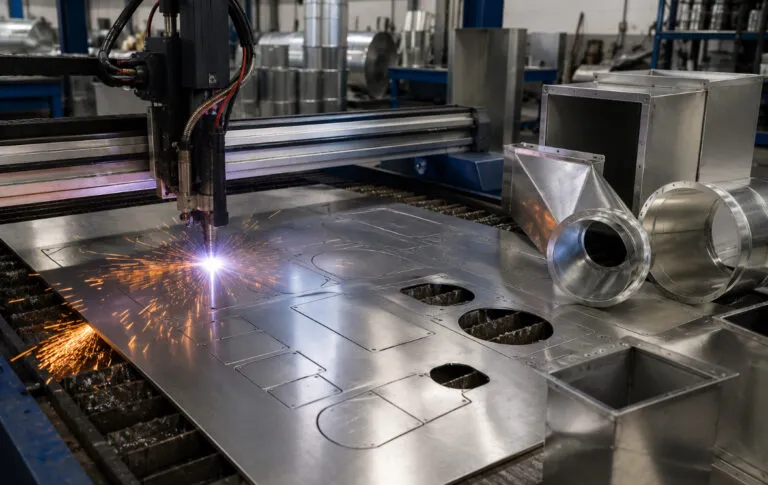
Parts are cut from whole sheets, often 4 by 8 feet, and even a good layout uses about 70% of a sheet. If 30 guards fit on a sheet and you order 40, two-thirds of the second sheet can end up as offcuts.
British Columbia


CHOOSING HOW MANY REPEAT PARTS TO ORDER AT A TIME
Order enough to spread the setup cost, and stop once the extra parts cost more to keep than they save.
Your reorder quantity is how many parts you order each time you go back for more. A bigger order shares the cost of getting the job ready across more parts, so each one costs less. Past a point, the extra parts sit on a shelf, and keeping them costs more than the setup they saved. This guide shows where that point sits, how a yearly order in batches works, and why a reorder can cost more.
The answer depends on a few facts about the part and how you use it. Find the ones that match your part, and see which way each one points.
| If this is true | Lean toward | Why |
|---|---|---|
| Setup is a big share of what each part costs | A bigger order | Each extra part shares a cost you pay once per order |
| The drawing may change in the next few months | A smaller order | Parts made to an old revision can end up as scrap |
| You use the part at a steady pace all year | A yearly order delivered in batches | You get the price for the full year without storing it all |
| Storage space is short, or the parts scratch or rust on a shelf | A smaller order | Every part you keep costs space and handling, and some get damaged |
| The part is powder coated or plated | Enough to clear the finisher's minimum charge | Below that minimum, a small batch pays the full charge on its own |
| One sheet of metal holds more parts than you're ordering | A quantity that fills whole sheets | The rest of the sheet may end up as offcuts you're paying for anyway |
If two rows disagree, give the drawing the final say. Order small until the change is approved, then order for the year.
Two costs decide the best order size, and they move in opposite directions as the order grows.
Setup cost covers checking the drawing, loading the program, setting up the machines, checking the first part, and the paperwork. If you order twice as often, you pay it twice as often.
Carrying cost is what stock costs to keep, from the cash tied up to the space, insurance, damage, and parts that go out of date. BDC, the Business Development Bank of Canada, puts it at 20 to 30% of the stock's value each year.
If you order more each time, you pay for fewer setups in a year. You also keep more parts in stock, and each one adds to the carrying cost.
Yearly use sets everything else. If you know you'll use 240 a year, you can see how many orders a year each order size means.

The lowest total comes where the two costs are about equal over a year. Below that size, you pay for too many setups, and above it you pay carrying cost on parts you won't need for months.
A price break is a lower price for each part once the order passes a set quantity. Most of it comes from sharing the setup, and the rest of the price barely moves.
If one setup covers 100 parts instead of 20, each part carries a fifth of it. Nearly all the savings come from this.
Each part needs its own metal, so the metal in it costs much the same whether you order 20 or 200.
Every part still has to be cut, folded, and checked. A bigger order lowers each part's share of the setup, not its time on the machines.
A finisher's minimum charge and the number of parts that fit on a sheet change the price in jumps. Ask where the jumps fall for your part.
Once the setup's share is small next to the metal and machine time, ordering more barely changes the price of each part. The page on why small custom metal parts cost more shows how fast that share falls from one part to fifty.
The total for a year changes slowly near the best order size and fast far from it. This pattern comes from the economic order quantity formula taught in business and engineering courses, so it holds for any part and any market.
| Order size, compared with the best size | Yearly setup and carrying cost, compared with the lowest | What it means for your order |
|---|---|---|
| Half the best size | 25% more | You pay for twice as many setups as you need |
| Three quarters of the best size | About 4% more | Close enough, and less stock if the drawing changes |
| The best size | The lowest total | Setup and carrying cost are about equal for the year |
| A quarter more than the best size | About 2.5% more | Close enough, and handy for rounding up to a full sheet |
| One and a half times the best size | About 8% more | Still close, as long as the drawing won't change |
| Double the best size | 25% more | Take a price break here only if it saves more than the extra 25% |
| Five times the best size | 160% more | Most of what you spend goes on keeping parts on a shelf |
Ordering too few costs more than ordering the same share too many. Half the best size adds 25%, while one and a half times adds about 8%. You don't have to hit the best size exactly, just get near it.
The yearly total is lowest where setup and carrying cost meet
Guard MG-220, 240 a year, $180 setup for each order, $40 a guard, 25% a year to keep stock. Illustration in Canadian dollars, not a Duct Duct Goose quote.
Not a Duct Duct Goose quote.
This example follows a guard, MG-220, that an equipment maker fits to 240 machines a year. The figures are assumed for the illustration, in Canadian dollars, and they're not a Duct Duct Goose quote.
It assumes $180 in setup cost for each order and $40 for each guard before setup. Carrying cost is 25% a year, the middle of BDC's range, charged on the average stock, which is half of each order.
| How it's ordered, an illustration in Canadian dollars and not a Duct Duct Goose quote | Orders a year | Setup cost for the year | Carrying cost for the year | Total for the year |
|---|---|---|---|---|
| 20 guards every month | 12 | $2,160 | $100 | $2,260 |
| 60 guards every quarter | 4 | $720 | $300 | $1,020 |
| 120 guards twice a year | 2 | $360 | $600 | $960 |
| All 240 guards at once, not a Duct Duct Goose quote | 1 | $180 | $1,200 | $1,380 |
The guards themselves cost $9,600 for the year whichever way they're ordered, as an illustration, not a Duct Duct Goose quote. The best order size here works out to about 93 guards. Orders of 60 and 120 both land within 10% of the lowest total, and monthly orders cost more than twice as much.
To find the best size for your own part, multiply 2 by your yearly use and by the setup cost. Divide by the carrying cost of one part for a year, then take the square root. Here, that's 2 × 240 × 180, divided by 10, which comes to about 93.
Buying all 240 at once beats monthly orders, until the drawing changes. If a new revision arrives halfway through the year, about 120 guards are left in stock, made to the old drawing.
A blanket order fixes a price for a year's quantity, and you release batches as you need them. Government of Canada buyers call the same idea a standing offer, and each release a call-up.
The price is set for the full year's quantity, so each batch is priced as part of the larger order. Ask whether the fabricator you're using works this way.
You say when each batch is made and where it goes. Your stockroom holds a quarter's guards instead of a year's.
If your year runs short, who keeps parts already made, and who pays for them? Put the answer in the order before the first batch.
A year is long enough for a drawing to change. Name the letter on each release, so a new revision starts where you want it.
Drawing Revision Control on Repeat Parts explains how to number a change partway through a year.
Some costs don't fall smoothly as the order grows. They jump at certain quantities, and a small change to the order size can put you on the better side of a jump.
Parts are cut from whole sheets, often 4 by 8 feet, and even a good layout uses about 70% of a sheet. If 30 guards fit on a sheet and you order 40, two-thirds of the second sheet can end up as offcuts.
Powder coating and plating usually go to a finisher, who charges a minimum for each batch and often a setup for each colour. A small batch in its own colour pays that charge alone.
When you ask for a price, ask how many fit on a sheet. Rounding the order up to fill the last sheet often adds parts for little more than the metal in them.
A repeat part doesn't always come back at the same price. Four things usually move it, and each one has something you can do about it.
| What changed | What it does to the price | What to do |
|---|---|---|
| Steel prices moved | Steel prices in Canada can move more than 10% between one order and the next, going by Statistics Canada's price index | Ask for a new price before each order, and order soon after you get it |
| The last quote has expired | The old price no longer holds, because quotes carry an end date | Check the end date on the quote before you count on its price |
| You're ordering fewer this time | The same setup is shared by fewer parts, so each one costs more | Combine two small orders, or give your yearly use with the order |
| The drawing has a new revision | The program changes, and the first part needs checking again | Send the new drawing with a note on what changed |
If the new price surprises you, ask which of these four moved it. A first quote and a revised one are compared in Why a Fabrication Quote Changes.
Most of these come from setting the order size on the price of one part alone. Each one has a simple fix.
| Mistake | What it costs | Do this instead |
|---|---|---|
| Buying a year's stock right before a drawing change | Parts made to the old revision may never be used | Order a smaller batch until the change is approved |
| Doubling the order to reach a price break | About 25% more in setup and carrying cost for the year, if you were near the best size | Take the break only if it saves more than that extra cost |
| A new colour on a small batch | The batch pays the finisher's minimum charge and colour setup on its own | Keep one colour, or order the new colour in one larger batch |
| A quantity that leaves most of a sheet unused | You pay for metal that ends up as offcuts | Ask how many fit on a sheet, and round to it |
| Ordering without checking the stockroom | Two batches of the same part sit side by side | Count what's on hand before you place the order |
Repeat parts are cut, formed, welded, and assembled on our floor in Pitt Meadows. We follow the same five steps for 20 parts or 200.
Send the part number, revision letter, and quantity. Add how many you use in a year, so we can see where your order sits.
We check the order against the drawing on file. If the letter doesn't match, we ask before pricing anything.
We price the order. If tooled production or a stock part would cost you less, we'll say so.
We make and check the batch. Each part is checked for its dimensions, material, finish, and revision before it leaves.
The drawing stays on file. The next reorder starts from the same drawing and revision.
If a batch doesn't match the drawing and the mistake was ours, we fix or remake it at no charge. Brackets, guards, and stands like the guard in the example are covered on our custom metal supports and enclosures page. Each one is shaped through our cutting and bending work.
Changing how many you order helps most when setup is a big share of the price. When the cost sits in the part itself, a bigger order won't fix it.

If a bigger order won't save you anything worth the space it takes, we'll tell you before you commit to it. In duck, duck, goose, nobody knows who's next, and your reorder size shouldn't be that kind of guess.
Parts that run into the thousands a year are compared with a production run in Small Batch Metal Fabrication. Design details that add shop time are in Why Small Custom Metal Parts Cost More.
A few facts about how you use the part point to an order size that makes sense. Each item below can change the answer.
Sheet Metal Prototype to Production lists what a first order needs on top of this. More guides for repeat parts are in OEM, Prototype and Repeat Production.
A drawing with a yearly number and a part number with a rough guess are both a fine place to start. We'll tell you what's missing before anything is priced.
Standard ductwork and fittings price instantly on WebDuct, the online pricing and ordering portal, with a company account. Prototypes, production parts, stainless, and other custom work start with a request or a call.
