
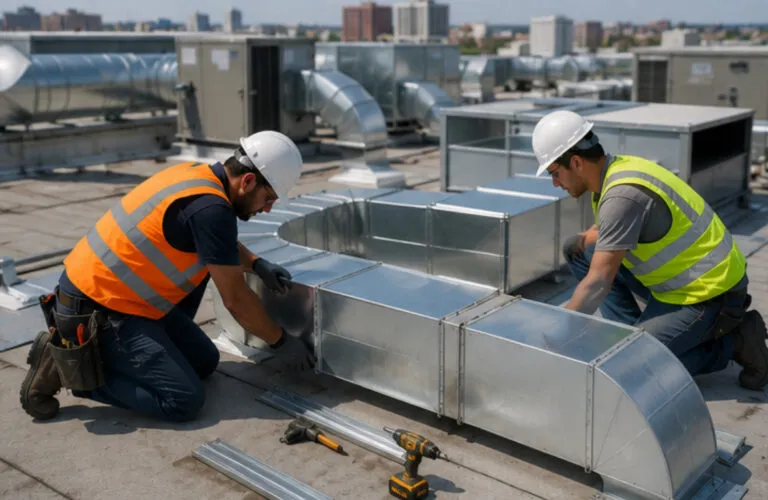
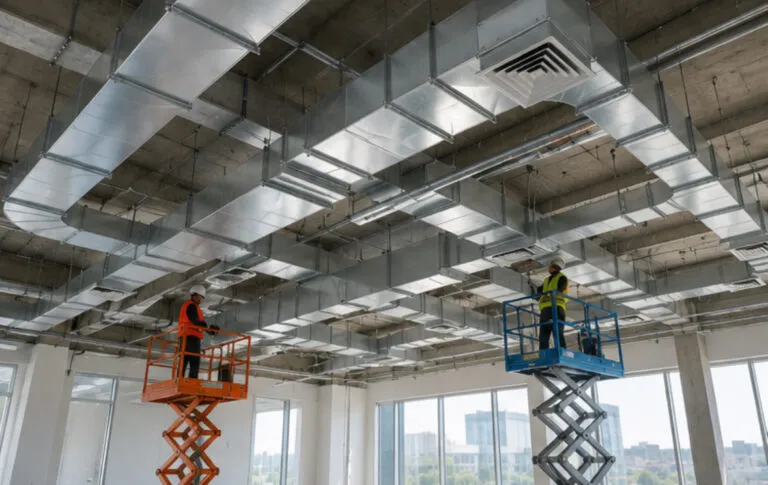
By floor, for buildings that go up level by level
If the install runs one floor at a time, floor labels let each load go straight to its level. They're commonly used on multi-storey new builds.
British Columbia


PLANNING DELIVERY DAY FOR FABRICATED METAL ON A BUSY SITE
A larger order sent in stages can go straight to the floor it's installed on, instead of sitting in every other trade's way.
A construction site delivery goes well when the metal arrives in the order it's installed and at a time the site can take it. Someone also needs to be there to receive it. On a British Columbia site, the delivery rules come from the prime contractor, usually the general contractor (GC) running the site. On larger orders, Duct Duct Goose labels each piece by floor, area, or system, sends the order in stages, and helps unload. What's left to plan is where the metal sits and how it stays clean until it goes up.
Six answers agreed before the load leaves Pitt Meadows save most of the waiting on delivery day. Most come from the GC, and the rest from your site lead and us.
| Question | Why it matters | Who usually answers it |
|---|---|---|
| When can the site take a delivery? | A truck that arrives outside site hours may have nowhere to stop | The GC |
| Where does the truck stop and unload? | The spot decides how far the metal is carried by hand | The GC |
| Who receives the order? | Someone has to count the pieces before signing for them | Your site lead |
| Where does the metal go once it's off the truck? | Metal with no planned spot gets moved again and again, and ends up in other trades' way | Your site lead, within the site's storage plan |
| Can that floor carry the load? | A floor still under construction may hold less than a finished one | The GC |
| Should the order come in more than one load? | One big delivery needs room to store all of it until install | You, with us, when the order is placed |
When more than one employer works on a British Columbia site, one company coordinates everyone's safety, deliveries included. WorkSafeBC calls that company the prime contractor.
It coordinates every employer on site, so it sets delivery hours, gates, and where trucks stop. If no prime contractor is named in writing, the owner holds that role.
Your company tells the GC in advance when your work overlaps other trades', so they can plan around it. Book the delivery time with them, then send us the time and the unloading spot.
We work to the site's rules, at the time and unloading spot the site sets. Ask when you order whether yours counts as a larger order, with labels, stages, and unloading help.
Cities such as North Vancouver ask for a traffic management plan that names the prime contractor and the site's hours. If the truck has to stop on the street, ask the prime contractor what the traffic plan allows.

A staged delivery splits one larger order into loads that arrive as each floor or area is ready. One delivery brings everything at once.
| Option | When it suits | Commonly used for |
|---|---|---|
| One delivery | The order is small, or there's dry, secure room to store all of it | A single tenant fit-out, a rooftop unit swap, or a short duct run |
| Staged delivery, for larger orders | The site is tight, or the install runs over weeks, floor by floor | Multi-storey buildings, phased renovations, and sites with little storage space |
| Pickup from our shop | Your crew has a truck and the order loads by hand | Small orders and repeat fittings for crews who hang duct every week |
For a pickup, the order is ready at our shop in Pitt Meadows, and loading it is up to your crew. Each option's scope, and what an installed order adds, is laid out in supply only or supply and install.
On larger orders, we label each piece by floor, area, or system. Send the same names your drawings use, and the labels match the way your crew installs.
If the install runs one floor at a time, floor labels let each load go straight to its level. They're commonly used on multi-storey new builds.
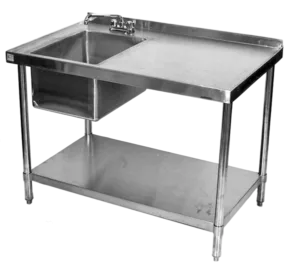
If one floor holds several zones or tenants, area labels keep each zone's fittings together. They're commonly used in retail units, labs, and kitchens.
If supply, return, and exhaust run side by side, system labels stop a fitting from going on the wrong run. They're commonly used in mechanical rooms and kitchen exhaust.
Labels in the names your drawings already use
On a larger order, each piece carries its floor, area, and system, so it goes straight to where it's installed.
Elbow
Transition
Straight duct
WorkSafeBC's construction rules cover the moment the truck arrives, as well as the work after it. Each one points to something to arrange before delivery day.
| What to arrange | The WorkSafeBC rule behind it | Who usually handles it |
|---|---|---|
| A clear route for the truck to the unloading spot | A construction site needs safe access for delivering materials | The GC |
| A walkway kept apart from the truck, and someone to guide it when it backs up | People on foot are kept apart from vehicles, and loads come off without creating a hazard | The GC, with the driver |
| Enough hands for long or awkward duct sections | Long or heavy duct needs enough people to carry it without strain, and employers must plan for that | Your crew, with our help on larger orders |
Duct stored in the right spot stays straight, clean, and out of the way until your crew needs it. On most sites, that spot is the laydown area, the space set aside for storing material.
Project specs ask for sheet material to sit on flat, solid supports, clear of the ground. If duct sits on bare slab or dirt, it picks up water and dents.
WorkSafeBC asks for stacks that are stable and secure, and walkways free of tripping hazards. If a stack could slide, strap it or lay it flat.
If a load is going onto an upper floor, find out what that floor can hold first. The GC knows the limit on a floor still under construction.
Some duct specs point to SMACNA guidelines that ask for open ends to be covered or capped, so dust and debris stay out of the duct. Your project spec sets how far to go.
Galvanized and stainless steel are harmed by different things on a jobsite, so each one needs its own care until installation. Ductwork is often galvanized, and the kitchen pieces we make are stainless.
| Metal | What harms it on site | How to prevent it |
|---|---|---|
| Galvanized ductwork, stacked | Water trapped between pieces leaves white rust, a powdery stain on the zinc coating | Keep it under cover and dry, and separate the pieces so each one dries if a stack gets wet |
| Galvanized ductwork, wrapped | Plastic sealed tight over wet metal holds the moisture in | Cover it loosely so air can move, and never wrap it wet |
| Stainless kitchen pieces and stainless duct | Grinding dust from carbon steel, or tools used on carbon steel, can leave rust spots | Store it away from carbon steel, keep the protective film on until install, and use clean tools |
A stainless finish can be scratched or stained before the kitchen even opens. Stainless steel finishes explained shows how each finish holds up and how to care for it.
Most delivery-day delays start with one of these six mistakes. Each one is fixed with a phone call or a note on the order before the truck leaves.
| The mistake | What happens | What to do instead |
|---|---|---|
| Sending a large order all at once to a tight site | The metal fills space other trades need, and gets moved more than once | Split the large order into loads that follow the install order |
| Naming nobody to receive the delivery | The driver waits, or the load is left where nobody planned | Put a name and a phone number on the order |
| Booking a time outside the site's delivery hours | The truck may have nowhere to stop and unload | Check the site's delivery hours before you book |
| Sending no floor, area, or system names | The labels don't match the way your crew installs | Send the names your drawings use with the order |
| Leaving duct on bare ground or in a walkway | It gets wet, dented, or moved by another trade | Put it in the laydown area on flat supports |
| Signing for the load without counting it | A missing or damaged piece is harder to sort out later | Count the pieces against the packing slip before you sign |
Counting before you sign is the first check on every load. If a piece does turn up damaged or wrong, what happens when wrong parts are delivered covers what to record before anyone installs it.
This six-storey office building is an illustration, not a Duct Duct Goose job. The roof curbs go in early with the roofing, and the duct goes up three floors at a time.
| Load and timing | What's on it | Where it's received |
|---|---|---|
| Load 1, while the roof is being built | The roof curbs, labelled Roof | Lifted to the roof on the GC's crane day |
| Load 2, when floors 1 to 3 are ready for duct | Ductwork and fittings labelled Floor 1, Floor 2, and Floor 3 | The ground-floor laydown area, then carried to each floor |
| Load 3, once floors 1 to 3 are hung | Ductwork and fittings labelled Floor 4, Floor 5, and Floor 6 | Taken up on the site's hoist, booked through the GC |
No floor holds more duct than its installers can hang before the next load, and nothing sits for weeks under other trades' feet. Each load also arrives sorted, because the labels match the floors.
One six-storey job, three loads
An illustration, not a Duct Duct Goose job. Each load arrives when its part of the building is ready.
While the roof is being built
Roof curbs labelled Roof, lifted up on the GC's crane day.
When floors 1 to 3 are ready for duct
Ductwork and fittings labelled Floor 1, 2, and 3, received at the ground-floor laydown area.
Once floors 1 to 3 are hung
Ductwork and fittings labelled Floor 4, 5, and 6, taken up on the site's hoist.
No floor holds more duct than its installers can hang before the next load.
Planning starts when the order goes in, not on delivery day. The earlier we know the site's rules, the easier each load is to book.
Tell us the site address, the receiver, and when the site can take it. Add the unloading spot if one is set.
Tell us if it's a larger order. We label it with your floor, area, and system names, and agree on the loads.
We deliver in our van or with a delivery service. A larger order comes at a booked time or in the site's loading window.
We help unload larger orders on site. Your crew moves the metal from the unloading spot to where it's installed.
Our HVAC ductwork fabrication and grease ductwork fabrication pages show what goes into each kind of order before it's loaded. Either one can be picked up, delivered, or sent in loads for a larger job.
We deliver across the areas we serve in Metro Vancouver and the Fraser Valley. A few parts of getting metal onto a site belong to the site itself.
Labels by floor, area, or system, loads sent in stages, delivery at a booked time or loading window, and help unloading larger orders.
Street-use and traffic permits, the hoist or crane, the laydown area, and storing metal until installation. Ask the GC about each one before delivery day.

For a small order, a pickup on your way past Pitt Meadows may be quicker than booking a delivery. We'll suggest it when it saves you time.
With these in hand, the driver knows where to go, and the right person is there to meet the load. Send them with the order, and tell us if the site's plan changes.
When our installers put the metal up too, site conditions that change a ductwork installation cost cover the access and lifting details to send. More guides on measuring, scope, and the install sit in Field Measure, Fit and Installation.
Send clean drawings or a sketch with sizes, plus the site address and the window that suits your schedule. We'll tell you what's missing and plan the loads around your install.
Standard ductwork and fittings price instantly on WebDuct, the online pricing and ordering portal, with a company account. Stainless, grease duct, installs, and other custom work start with a request or a call.
